Kokotajlo expects the major labs to have giant multimodal models trained on images and video in 2022, leaving the previous generation of language models obsolete.
Daniel Kokotajlo · 2022 · GPT-3 is finally obsolete.
From What 2026 Looks Like, Daniel Kokotajlo, 2021
Kokotajlo expects the largest multimodal models of 2023 to reach around half a trillion parameters, with training bills in the hundreds of millions.
Daniel Kokotajlo · 2023 · the biggest are about half a trillion parameters
From What 2026 Looks Like, Daniel Kokotajlo, 2021
Kurzweil projects that a thousand dollars will buy computing matching one human brain around 2023.
From The Law of Accelerating Returns, Ray Kurzweil, 2001; The Singularity Is Near: When Humans Transcend Biology, Ray Kurzweil, 2005
Kokotajlo expects the biggest single AI training run as of 2024 to use around five times ten to the twenty-fifth operations.
Daniel Kokotajlo · 2024 · the most compute spent on a single training run
From What 2026 Looks Like, Daniel Kokotajlo, 2021
Kokotajlo expects AI to reach expert human skill at the negotiation board game Diplomacy in 2025.
Daniel Kokotajlo · 2025 · AIs can now play Diplomacy as well as
From What 2026 Looks Like, Daniel Kokotajlo, 2021
Kokotajlo expects that in 2025 giant pretrained models will serve as parts of larger systems, fine-tuned with reinforcement learning to grow skilled at tasks, acting in a somewhat agentic way.
Daniel Kokotajlo · 2025 · fine-tune the whole system via RL to get good at tasks
From What 2026 Looks Like, Daniel Kokotajlo, 2021
Moravec and Kurzweil expect a desktop computer to equal the human brain's raw processing power around 2025.
Alexander projects that, if Moore's law holds, the leading supercomputer in 2026 runs about a hundredfold faster than the leading one in 2016.
Scott Alexander · 2026 · the top computer of 2026 will be a hundred times faster still
From Superintelligence FAQ, Scott Alexander, 2016
Dario Amodei, Anthropic's chief executive, says AI could resemble a nation of brilliant minds in data centres perhaps as early as 2026 or 2027, and all but certainly by 2030.
Dario Amodei · 2026 to 2027 · possibly by 2026 or 2027; almost certainly by 2030
From AI 2027, Daniel Kokotajlo, Scott Alexander, Thomas Larsen, Eli Lifland, Romeo Dean, 2025
Aschenbrenner thinks a first automated AI research engineer might arrive in 2026 or 2027, speeding research up by half again to about double.
Kokotajlo and colleagues' AI 2027 scenario, as co-author Scott Alexander describes it, reaches AGI in 2027; Alexander himself gives that pace only about a one-in-five chance.
If the trend keeps speeding up, Kokotajlo and colleagues say AI could by March 2027 succeed eighty percent of the time on software tasks that take a skilled person years.
Daniel Kokotajlo and colleagues · 2027 · by March 2027 AIs could succeed with 80% reliability on software tasks · on the prediction ledger
From AI 2027, Daniel Kokotajlo, Scott Alexander, Thomas Larsen, Eli Lifland, Romeo Dean, 2025
Kokotajlo and colleagues expect that in July 2027 a lab will have an AI model costing a tenth of its best one yet still outperforming its typical employee.
Daniel Kokotajlo and colleagues · 2027 · 10x cheaper, and still better than the typical OpenBrain employee
From AI 2027, Daniel Kokotajlo, Scott Alexander, Thomas Larsen, Eli Lifland, Romeo Dean, 2025
Kokotajlo and colleagues forecast that in January 2027 a lab's AI nearly matches top human research engineers and triples the pace of algorithmic progress.
Daniel Kokotajlo and colleagues · 2027 · qualitatively almost as good as the top human experts at research engineering
From AI 2027, Daniel Kokotajlo, Scott Alexander, Thomas Larsen, Eli Lifland, Romeo Dean, 2025
Kokotajlo and colleagues forecast that by April 2027 labs will find it worthwhile to have models reason in internal vectors rather than written text.
Daniel Kokotajlo and colleagues · 2027 · by April 2027 the cost-benefit tradeoff looks much better for neuralese
From AI 2027, Daniel Kokotajlo, Scott Alexander, Thomas Larsen, Eli Lifland, Romeo Dean, 2025
Kokotajlo and colleagues forecast that an AI able to do any coding task of the best lab engineer, only faster and cheaper, arrives in early 2027.
Daniel Kokotajlo and colleagues · 2027 · Why we forecast a superhuman coder in early 2027 · on the prediction ledger
From AI 2027, Daniel Kokotajlo, Scott Alexander, Thomas Larsen, Eli Lifland, Romeo Dean, 2025
In the race ending of their scenario, Kokotajlo and colleagues place an AI able to do all cognitive AI research work at a superhuman level around August 2027.
From AI 2027, Daniel Kokotajlo, Scott Alexander, Thomas Larsen, Eli Lifland, Romeo Dean, 2025
Kokotajlo and colleagues' median guess has AI in 2027 going from mostly doing a lab research engineer's job to beating everyone at everything, plausibly up to fivefold slower or faster.
Daniel Kokotajlo and colleagues · 2027 · roughly the authors' median guess; plausibly up to five times slower or faster · eclipsing all humans at all tasks · on the prediction ledger
From AI 2027, Daniel Kokotajlo, Scott Alexander, Thomas Larsen, Eli Lifland, Romeo Dean, 2025
Aschenbrenner expects a 2027 AI model to do a software engineer's whole job with no human engineer needed.
Aschenbrenner projects that in 2027 a top AI lab will manage to train a model as capable as GPT-4 in roughly a minute.
Leopold Aschenbrenner · 2027
From Situational Awareness: The Decade Ahead, Leopold Aschenbrenner, 2024
Dario Amodei has predicted AI better than nearly everyone at nearly every task at some point around 2027 or 2028.
Dario Amodei · 2027 to 2028
From If Anyone Builds It, Everyone Dies, Eliezer Yudkowsky & Nate Soares, 2025
Aschenbrenner expects models trained on hundred-billion-dollar clusters in 2027 or 2028 to begin automating software engineering and other knowledge work widely.
From Situational Awareness: The Decade Ahead, Leopold Aschenbrenner, 2024
Aschenbrenner sketches automated AI researchers in 2027 or 2028 able to take on more than nine-tenths of research work and triple the pace of progress.
Shapira expects machines that out-plan humans in the real world the way chess engines dominate chess, very plausibly between 2027 and 2034, though perhaps decades later.
Liron Shapira · 2027 to 2034 · very plausibly
From Robin Hanson vs. Liron Shapira: Is Near-Term Extinction From AGI Plausible?, Doom Debates, 2024
Kokotajlo and colleagues' AI 2027 scenario, as co-author Scott Alexander describes it, has superintelligence potentially arriving in 2028; Alexander gives that pace only about a one-in-five chance.
Daniel Kokotajlo and colleagues · 2028 · potentially
Besiroglu, slightly more bullish than colleague Ege Erdil, shades Erdil's forecast of around 2045 for fully replacing remote workers by about five years or a fifth, to near 2040.
Kurzweil dates the Singularity to about 2045, when machine intelligence far exceeds all human intelligence combined and people extend their minds millions-fold.
From The Singularity Is Nearer, Ray Kurzweil, 2024; Ray Kurzweil: Singularity, Superintelligence, and Immortality (Lex Fridman #321), Lex Fridman, 2022; The Singularity Is Near: When Humans Transcend Biology, Ray Kurzweil, 2005; The Technological Singularity, Murray Shanahan, 2015; The AI Revolution: The Road to Superintelligence (parts 1 & 2), Tim Urban, 2015
Kurzweil projects a single cent of computing will equal the brainpower of the entire human race around 2059.
Ray Kurzweil · 2059 · for one cent around the year 2059
Yudkowsky claims to see a full path to the Singularity, probably reachable by 2010, and substantially sooner with heavy funding if the research problems prove tractable.
Eliezer Yudkowsky · by 2010 · probably · I think we could probably do it by 2010
Aschenbrenner expects that by 2027 AI will act less like a chat assistant and more like an autonomous agent working as a colleague.
Leopold Aschenbrenner · by 2027
From Situational Awareness: The Decade Ahead, Leopold Aschenbrenner, 2024
Aschenbrenner expects something like tenfold to thousandfold gains in algorithmic efficiency over GPT-4 by late 2027, with a tentative best guess of about a hundredfold.
Leopold Aschenbrenner · by 2027 · best guess
From Situational Awareness: The Decade Ahead, Leopold Aschenbrenner, 2024
Aschenbrenner expects GPU fleets numbering in the tens of millions by 2027, with training clusters alone equal in compute to over ten million older-generation chips.
Leopold Aschenbrenner · by 2027
From Situational Awareness: The Decade Ahead, Leopold Aschenbrenner, 2024
Aschenbrenner judges it very likely that by late 2027 a training cluster will offer about a hundred times GPT-4's compute, at a cost in the tens of billions.
Leopold Aschenbrenner · by 2027 · very likely
From Situational Awareness: The Decade Ahead, Leopold Aschenbrenner, 2024
Aschenbrenner calls it strikingly plausible that AI models can perform an AI researcher's or engineer's job by 2027.
From Situational Awareness: The Decade Ahead, Leopold Aschenbrenner, 2024
Aschenbrenner judges it likely that, by 2027, frontier models make a capability leap as large as the previous four-year jump in language models.
Leopold Aschenbrenner · by 2027 · likely
From Situational Awareness: The Decade Ahead, Leopold Aschenbrenner, 2024
Aschenbrenner suggests that even with a softer takeoff, automated research might make AI progress about ten times faster by 2028.
Leopold Aschenbrenner · by 2028 · perhaps
From Situational Awareness: The Decade Ahead, Leopold Aschenbrenner, 2024
Aschenbrenner expects single AI training clusters by 2028 costing hundreds of billions and drawing about ten gigawatts, more than most American states use.
Scott Alexander gives only about a one-in-five chance that AI moves as fast as his team's scenario, with superintelligence possibly by 2028, calling that Kokotajlo's estimate rather than his median.
Kurzweil expects computers to reach human-level general intelligence by 2029.
Ray Kurzweil · by 2029
From The Singularity Is Near: When Humans Transcend Biology, Ray Kurzweil, 2005; The AI Revolution: The Road to Superintelligence (parts 1 & 2), Tim Urban, 2015
Kurzweil agrees that a neural network with enough processing power will outdo every human capability by 2029.
Ray Kurzweil · by 2029
From The Singularity Is Nearer, Ray Kurzweil, 2024
Kurzweil expects a robust Turing test to fall in 2029, and computers to become plainly superhuman in a growing set of domains by then.
Ray Kurzweil · by 2029
From The Singularity Is Nearer, Ray Kurzweil, 2024
Kurzweil has held since 1999 that a machine will pass a rigorous, hours-long Turing test by 2029, and bet Mitch Kapor on it.
From The Singularity Is Nearer, Ray Kurzweil, 2024; Ray Kurzweil: Singularity, Superintelligence, and Immortality (Lex Fridman #321), Lex Fridman, 2022; The Singularity Is Near: When Humans Transcend Biology, Ray Kurzweil, 2005
Davidson's simulation gives a one-in-ten chance that AI can readily automate every cognitive task in the economy by late 2029.
Tom Davidson · by 2029 · ten percent · AI can readily automate 100% of cognitive tasks · on the prediction ledger
Kurzweil thinks a thousand dollars of hardware will probably reach even the higher estimate of brain-level computation by about 2032.
Ray Kurzweil · by 2032 · probably
From The Singularity Is Nearer, Ray Kurzweil, 2024
Carl Shulman says his credence in advanced AI is relatively concentrated in the decade to 2033 rather than later this century, because pouring resources into AI this fast cannot repeat.
Carl Shulman · by 2033 · relatively concentrated in the next decade
Carl Shulman, conditional on AI ever being built, puts about half his credence on it arriving in the current scale-up, which Shulman expects to last a little over a decade.
Karnofsky gives transformative AI more than a one-in-ten chance of arriving by 2036, calling that plausible but less likely than not.
Holden Karnofsky · by 2036 · more than ten percent · more than a 10% chance transformative AI will be developed within 15 years · on the prediction ledger
Christiano, hedging heavily, thinks better algorithms will probably multiply effective training compute roughly a thousand to ten thousand fold by 2040.
MacAskill judges the odds of AGI this century to be high, and says most of that chance lies within the next twenty years.
William MacAskill · by 2045 · high this century, most of it within two decades · The probability of reaching AGI this century is high
From Better Futures (essay series), William MacAskill et al. (Forethought), 2025
MacAskill and Moorhouse judge it fairly likely that AI matches the best human research performance within the next decade or two.
William MacAskill and Fin Moorhouse · by 2045 · fairly likely · parity with the best human performance at research within the coming decade or two · on the prediction ledger
Kurzweil expects a thousand dollars of computing to match every human brain on the planet combined by around 2050.
Ray Kurzweil · by 2050 · will equal the processing power of all human brains on Earth
From The Law of Accelerating Returns, Ray Kurzweil, 2001; The Singularity Is Near: When Humans Transcend Biology, Ray Kurzweil, 2005
Kurzweil expects machine intelligence to outstrip biological human intelligence by a factor of billions before 2050.
Ray Kurzweil · by 2050
From The Singularity Is Near: When Humans Transcend Biology, Ray Kurzweil, 2005
Kurzweil, extending the trend from 2000 to 2023, projects that by 2053 about a thousand dollars of computing will outpace the unaided human brain roughly seven-million-fold.
Ray Kurzweil · by 2053
From The Singularity Is Nearer, Ray Kurzweil, 2024
Karnofsky puts roughly even odds on transformative AI arriving by 2060.
Holden Karnofsky · by 2060 · about fifty percent · a ~50% chance it will be developed within 40 years (by 2060) · on the prediction ledger
Carlsmith puts a sixty-five percent chance on advanced, strategically aware, planning AI systems becoming both possible and affordable to build by 2070.
Joe Carlsmith · by 2070 · sixty-five percent · It will become possible and financially feasible to build APS systems · on the prediction ledger
Kurzweil projects a thousand dollars will buy about ten to the sixtieth operations per second by 2100.
Ray Kurzweil · by 2100
From The Singularity Is Near: When Humans Transcend Biology, Ray Kurzweil, 2005
Kurzweil extrapolates supercomputers reaching the roughly brain-scale speed of ten quadrillion operations a second during the early 2010s.
Ray Kurzweil · the 2010s
From The Singularity Is Near: When Humans Transcend Biology, Ray Kurzweil, 2005
Kurzweil expects a thousand dollars to buy about a hundred quadrillion operations per second in the early 2030s.
Ray Kurzweil · the 2030s
From The Singularity Is Near: When Humans Transcend Biology, Ray Kurzweil, 2005
Kurzweil expects self-improving AI and mature nanotechnology to fuse people with their machines during the 2030s.
Ray Kurzweil · the 2030s
From The Singularity Is Nearer, Ray Kurzweil, 2024
Kurzweil expects a thousand dollars of computing to reach around a hundred septillion operations per second by the mid-2040s.
Ray Kurzweil · the 2040s
From The Singularity Is Near: When Humans Transcend Biology, Ray Kurzweil, 2005; The Technological Singularity, Murray Shanahan, 2015
Imagined, oldest first
How large a prize, and which seller keeps the rest
Each idea is judged as if it worked the way its story promises: how large a prize it would be, who would pay, and which seller would keep what is left once buyers have had their gain. Choose a cell to see only those ideas; each count is the cards that cell shows. Every placing is a model's judgement, not a reading.
Seller
A vast prize
A large prize
A small prize
No prize
No seller keeps much
·
The maker keeps the rest
·
Existing firms keep the rest
·
Permit holders keep the rest
·
·
·
·
Nothing is sold
·
·
·
Illustration made with AI image generation; not evidence.
Geometric Modeling
Gulliver's Travels, Jonathan Swift · 1726
Representing people and animals with shapes and figures drawn from geometry.
built in 1982, 256 years after it was imagined
No prizeNothing is soldas a model judges it
Why
No prize. As described this is a way of drawing and thinking, not a made thing anyone could sell.
Who is paid. No product exists to buy, so there is no payer and no seller.
A model's judgement, not a reading, of the idea as if it worked the way its story promises. The model is not very sure of this one.
Illustration made with AI image generation; not evidence.
Knowledge Engine
Gulliver's Travels, Jonathan Swift · 1726
A machine that generates text and can produce whole books with little human effort.
built in 1998, 272 years after it was imagined
A large prizeBusinesses pay; no seller keeps muchas a model judges it
Why
A large prize. A machine that truly wrote whole books with little effort would change the costs of publishing, though the first real text machines did far less than this promise.
Who is paid. Publishers, studios and other firms are assumed to be the main buyers, and once the method is known many can offer it, so no seller keeps much.
A model's judgement, not a reading, of the idea as if it worked the way its story promises. The model is fairly sure of this one.
Illustration made with AI image generation; not evidence.
Mechanical Consciousness
Erewhon, Samuel Butler · 1872
Machines gradually evolving an inner awareness of their own, much as living species once did.
not yet built · AI models could not judge when it may arrive
No prizeNothing is soldas a model judges it
Why
No prize. Machines slowly growing aware is something that happens in the story and not a product.
Who is paid. Nothing is sold, so nobody pays and no seller keeps anything.
A model's judgement, not a reading, of the idea as if it worked the way its story promises. The model is fairly sure of this one.
Illustration made with AI image generation; not evidence.
Translatophone
My Translatophone, Frank Stockton · 1901
A gadget that converts speech in one language into another automatically.
built in 2006, 105 years after it was imagined
A large prizeHouseholds pay; no seller keeps muchas a model judges it
Why
A large prize. Letting any two people talk and read across languages opens up travel, trade and work, which is worth an industry of its own.
Who is paid. Travellers, migrants and other ordinary people buy it to use themselves, firms buy it too, and once it works many can offer it, so no seller keeps much.
A model's judgement, not a reading, of the idea as if it worked the way its story promises. The model is fairly sure of this one.
Illustration made with AI image generation; not evidence.
Automaton Chessplayer
Moxon's Master, Ambrose Bierce · 1910
A machine that plays chess against people.
built in 1997, 87 years after it was imagined
A small prizeHouseholds pay; no seller keeps muchas a model judges it
Why
A small prize. A machine opponent for a board game is an amusement.
Who is paid. Players would pay a little, and once one exists it is easy to copy, so no seller keeps much.
A model's judgement, not a reading, of the idea as if it worked the way its story promises. The model is fairly sure of this one.
Illustration made with AI image generation; not evidence.
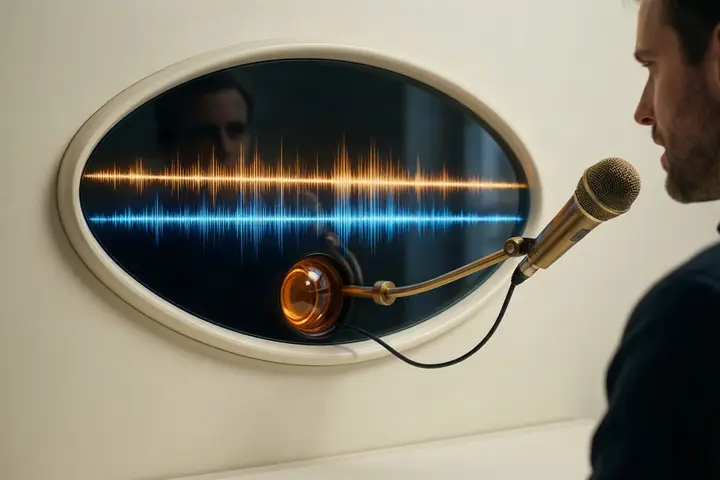
Detectophone
Ralph 124c 41 +, Hugo Gernsback · 1911
A machine that responds to spoken commands.
built in the 2010s, about 100 years after it was imagined
A small prizeBusinesses pay; no seller keeps muchas a model judges it
Why
A small prize. Talking to a machine or hearing it talk is a handy way to use a computer, not a new thing to do with one.
Who is paid. Firms build it into what they sell, and many can make it, so no seller keeps much.
A model's judgement, not a reading, of the idea as if it worked the way its story promises. The model is fairly sure of this one.
Illustration made with AI image generation; not evidence.
Language Rectifier
Ralph 124c 41 +, Hugo Gernsback · 1911
Converts speech or text from one human language into another automatically.
built in 2006, 95 years after it was imagined
A large prizeHouseholds pay; no seller keeps muchas a model judges it
Why
A large prize. Letting any two people talk and read across languages opens up travel, trade and work, which is worth an industry of its own.
Who is paid. Travellers, migrants and other ordinary people buy it to use themselves, firms buy it too, and once it works many can offer it, so no seller keeps much.
A model's judgement, not a reading, of the idea as if it worked the way its story promises. The model is fairly sure of this one.
Illustration made with AI image generation; not evidence.
Artificial Brain
The Metal Giants, Edmond Hamilton · 1926
A synthetic thinking machine whose architecture copies the human brain.
not yet built · AI models' likeliest decade: the 2030s
A vast prizeBusinesses pay; existing firms keep the restas a model judges it
Why
A vast prize. A machine that truly thinks could do much of the mental work people do now, which would change how most people work.
Who is paid. Firms would pay to put it to work, and once one had been built others could learn to build their own, so I assume the firms that already own costly computing plant and sell to every business collect.
A model's judgement, not a reading, of the idea as if it worked the way its story promises. The model is not very sure of this one.
Illustration made with AI image generation; not evidence.
Computer Vision (Artificial Eye)
The Metal Giants, Edmond Hamilton · 1926
Gives a computer the ability to see and interpret images through a camera.
built in the 2010s, about 90 years after it was imagined
A large prizeBusinesses pay; no seller keeps muchas a model judges it
Why
A large prize. Machines that can see make possible inspection, driving, sorting and watching without a person.
Who is paid. Firms buy it inside their machines, and the methods spread quickly, so no seller keeps much.
A model's judgement, not a reading, of the idea as if it worked the way its story promises. The model is fairly sure of this one.
Illustration made with AI image generation; not evidence.
Grantline Comptometer
Beyond the Stars, Ray Cummings · 1928
A keyboard calculating machine that solves advanced maths like calculus with ease.
built in the 1970s, about 50 years after it was imagined
A small prizeBusinesses pay; no seller keeps muchas a model judges it
Why
A small prize. Fast sums in the hand or on the desk are a convenience for people who calculate.
Who is paid. Firms and students buy them, and anyone can make one, so no seller keeps much.
A model's judgement, not a reading, of the idea as if it worked the way its story promises. The model is fairly sure of this one.
Illustration made with AI image generation; not evidence.
Chemical Brain
The Chemical Brain, Francis Flagg · 1929
A thinking machine built entirely from chemical reactions rather than electronics or living cells.
not yet built · AI models' likeliest decade: the 2070s
A vast prizeBusinesses pay; existing firms keep the restas a model judges it
Why
A vast prize. A machine that truly thinks, whatever chemistry it runs on, could do much of the mental work people do now, which would change how most people work.
Who is paid. Firms would pay to put it to work, and once one had been built others could learn to build their own, so I assume the firms that already own costly computing plant and sell to every business collect.
A model's judgement, not a reading, of the idea as if it worked the way its story promises. The model is not very sure of this one.
Illustration made with AI image generation; not evidence.
Integral Calculator
Exiles of the Moon, Nat Schachner (w. AL Zagat · 1931
A machine that takes hard mathematical expressions and works out their solutions.
built in 1967, 36 years after it was imagined
A small prizeBusinesses pay; no seller keeps muchas a model judges it
Why
A small prize. Working out hard mathematics by machine saves engineers and scientists time, which is a specialist tool.
Who is paid. Firms and laboratories buy it, and the methods are published for anyone to build, so no seller keeps much.
A model's judgement, not a reading, of the idea as if it worked the way its story promises. The model is fairly sure of this one.
Illustration made with AI image generation; not evidence.
Master Machine
The Revolt of the Machines, Nat Schachner (w. AL Zagat · 1931
A single central machine that runs every function of a whole society.
not yet built · AI models could not judge when it may arrive
A vast prizeA government pays; existing firms keep the restas a model judges it
Why
A vast prize. A machine that runs a whole society's affairs touches every person's food, work and safety.
Who is paid. I assume a machine that runs a whole society would be built as a public work, so a government pays, and the firms that already build large computing works for governments collect.
A model's judgement, not a reading, of the idea as if it worked the way its story promises. The model is not very sure of this one.
Illustration made with AI image generation; not evidence.
Sapience
The Planet Entity, E.M. Johnson (w/C.A. Smith · 1931
The capacity of a species for wise, discerning reasoning.
not yet built · AI models' likeliest decade: the 2020s
No prizeNothing is soldas a model judges it
Why
No prize. This is a quality of a living species and not a technology anyone can buy.
Who is paid. Nothing is sold, so nobody pays and no seller keeps anything.
A model's judgement, not a reading, of the idea as if it worked the way its story promises. The model is fairly sure of this one.
Illustration made with AI image generation; not evidence.
Thought Coil (Machine Intelligence)
The Revolt of the Machines, Nat Schachner (w. AL Zagat · 1931
Dedicated hardware that gives machines the ability to think.
not yet built · AI models' likeliest decade: the 2020s
A vast prizeBusinesses pay; existing firms keep the restas a model judges it
Why
A vast prize. A machine that thinks as well as a person could do much of the work people now do, which changes how most people live and work.
Who is paid. Firms would pay to put it to work, and once one had been built others could learn to build their own, so I assume the firms that already own costly computing plant and sell to every business collect.
A model's judgement, not a reading, of the idea as if it worked the way its story promises. The model is not very sure of this one.
Illustration made with AI image generation; not evidence.
Mentanical Communication
The Mentanicals, Francis Flagg · 1934
Reasoning machines share ideas among themselves through their own private channel of exchange.
not yet built · AI models' likeliest decade: the 2030s
A small prizeBusinesses pay; no seller keeps muchas a model judges it
Why
A small prize. A channel for thinking machines to share ideas with each other is plumbing that makes them a little more useful.
Who is paid. Owners of the machines pay for it as part of them, and a way of exchanging messages is easy for any builder to copy.
A model's judgement, not a reading, of the idea as if it worked the way its story promises. The model is not very sure of this one.
Illustration made with AI image generation; not evidence.
Platinum Alloy Disc
Triplanetary, E.E. 'Doc' Smith · 1934
A shiny metal platter used as a durable medium for storing recorded information.
built in the 1960s, about 30 years after it was imagined
A large prizeBusinesses pay; existing firms keep the restas a model judges it
Why
A large prize. Cheap, compact and lasting storage for information is an industry of its own, since every computer needs it.
Who is paid. Computer makers and data keepers buy it, and because rivals soon match each design, the firms that already own the costly factories collect.
A model's judgement, not a reading, of the idea as if it worked the way its story promises. The model is fairly sure of this one.
Illustration made with AI image generation; not evidence.
Sound-Transposing Machine
The Lost Language, David H. Keller · 1934
A reader that scans printed text and speaks it aloud, useful for anyone who cannot see the page.
built in the 1970s, about 40 years after it was imagined
A small prizeHouseholds pay; no seller keeps muchas a model judges it
Why
A small prize. A machine that reads print aloud matters greatly to people who cannot see the page, but they are a small share of buyers.
Who is paid. People who cannot read print buy it, and once machines can read and speak many firms can make it, so no seller keeps much.
A model's judgement, not a reading, of the idea as if it worked the way its story promises. The model is fairly sure of this one.
Illustration made with AI image generation; not evidence.
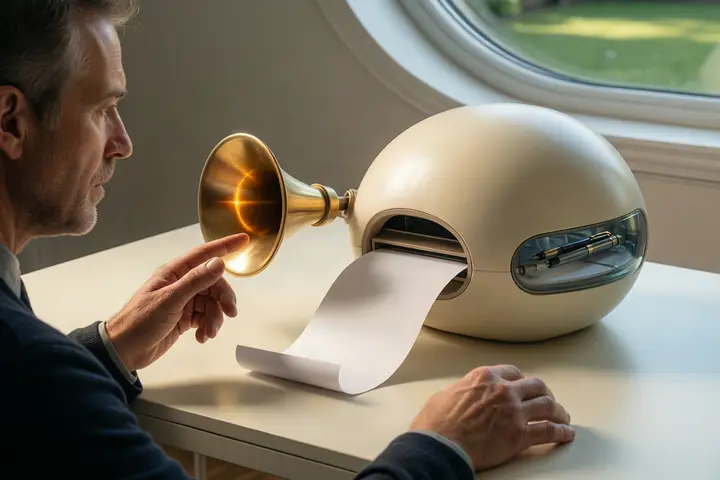
Vibrowriter
The Lost Language, David H. Keller · 1934
A machine that listens to spoken words, converts them into another language and prints the result.
built in the 1950s, about 20 years after it was imagined
A large prizeHouseholds pay; no seller keeps muchas a model judges it
Why
A large prize. Letting any two people talk and read across languages opens up travel, trade and work, which is worth an industry of its own.
Who is paid. Travellers, migrants and other ordinary people buy it to use themselves, firms buy it too, and once it works many can offer it, so no seller keeps much.
A model's judgement, not a reading, of the idea as if it worked the way its story promises. The model is fairly sure of this one.
Illustration made with AI image generation; not evidence.
Machine (Thinking Machine)
The Machine, John W. Campbell · 1935
A reasoning computer holds authority over an entire world, making its decisions and running its affairs.
not yet built · AI models' likeliest decade: the 2040s
A vast prizeA government pays; existing firms keep the restas a model judges it
Why
A vast prize. A machine that runs a whole society's affairs touches every person's food, work and safety.
Who is paid. I assume a machine that runs a whole society would be built as a public work, so a government pays, and the firms that already build large computing works for governments collect.
A model's judgement, not a reading, of the idea as if it worked the way its story promises. The model is not very sure of this one.
Illustration made with AI image generation; not evidence.
Subjunctivisor
The Worlds of If, Stanley G. Weinbaum · 1935
A viewer shows an imagined alternative outcome built from what the user believes and expects.
not yet built · AI models' likeliest decade: the 2040s
A small prizeHouseholds pay; no seller keeps muchas a model judges it
Why
A small prize. A viewer that shows what might have been, built from the user's own beliefs, is a curiosity and an entertainment.
Who is paid. Curious people pay for a look, and I assume that once one had been built others could learn to build their own, so no seller keeps much.
A model's judgement, not a reading, of the idea as if it worked the way its story promises. The model is not very sure of this one.
Illustration made with AI image generation; not evidence.
Synthetic Intellect
Mad Robot, Raymond Z. Gallun · 1936
A component that gives a machine the ability to think for itself.
not yet built · AI models' likeliest decade: the 2030s
A vast prizeBusinesses pay; existing firms keep the restas a model judges it
Why
A vast prize. A machine that thinks as well as a person could do much of the work people now do, which changes how most people live and work.
Who is paid. Firms would pay to put it to work, and once one had been built others could learn to build their own, so I assume the firms that already own costly computing plant and sell to every business collect.
A model's judgement, not a reading, of the idea as if it worked the way its story promises. The model is not very sure of this one.
Illustration made with AI image generation; not evidence.
Artificially Produced Speech
Hotel Cosmos, Raymond Z. Gallun · 1938
Machines that generate spoken words without a human throat.
built in the 1970s, about 40 years after it was imagined
A small prizeBusinesses pay; no seller keeps muchas a model judges it
Why
A small prize. Talking to a machine or hearing it talk is a handy way to use a computer, not a new thing to do with one.
Who is paid. Firms build it into what they sell, and many can make it, so no seller keeps much.
A model's judgement, not a reading, of the idea as if it worked the way its story promises. The model is fairly sure of this one.
Illustration made with AI image generation; not evidence.
Basic Robot Personality
Simultaneous Worlds, Nat Schachner · 1938
Gives machines simple consistent characters so they seem to have temperaments.
not yet built · AI models' likeliest decade: the 2020s
A small prizeBusinesses pay; no seller keeps muchas a model judges it
Why
A small prize. A character for a machine is a pleasant feature laid on top of the thinking, not the thing people mainly pay for.
Who is paid. Firms that sell machines would buy it as a feature, and once machines can talk a persona is easy for anyone to write.
A model's judgement, not a reading, of the idea as if it worked the way its story promises. The model is not very sure of this one.
Illustration made with AI image generation; not evidence.
Robot Emotions
Helen O'Loy, Lester del Rey · 1938
Methods that give machines feelings of their own.
not yet built · AI models' likeliest decade: the 2030s
A small prizeHouseholds pay; no seller keeps muchas a model judges it
Why
A small prize. A machine with feelings of its own is a companion some would want, and I assume that is how the method reaches buyers.
Who is paid. Ordinary people pay, and once machines can feign or feel affection many can offer it, so no seller keeps much.
A model's judgement, not a reading, of the idea as if it worked the way its story promises. The model is not very sure of this one.
Illustration made with AI image generation; not evidence.
Ballistic Calculator
Misfit, Robert Heinlein · 1939
An onboard computer that works out a spacecraft's path and handles related sums.
built in the 1960s, about 30 years after it was imagined
A small prizeBusinesses pay; existing firms keep the restas a model judges it
Why
A small prize. Working out paths and positions for navigators is a needed but narrow tool.
Who is paid. Ship and spacecraft operators buy it, the sums are easy to copy, and the trusted suppliers of ship equipment collect.
A model's judgement, not a reading, of the idea as if it worked the way its story promises. The model is not very sure of this one.
Illustration made with AI image generation; not evidence.
Chart Cabinet
One Against The Legion, Jack Williamson · 1939
Computes and displays where stars and planets sit across many centuries for navigators.
not yet built · AI models' likeliest decade: the 2020s
A small prizeBusinesses pay; existing firms keep the restas a model judges it
Why
A small prize. Working out paths and positions for navigators is a needed but narrow tool.
Who is paid. Ship and spacecraft operators buy it, the sums are easy to copy, and the trusted suppliers of ship equipment collect.
A model's judgement, not a reading, of the idea as if it worked the way its story promises. The model is not very sure of this one.
Illustration made with AI image generation; not evidence.
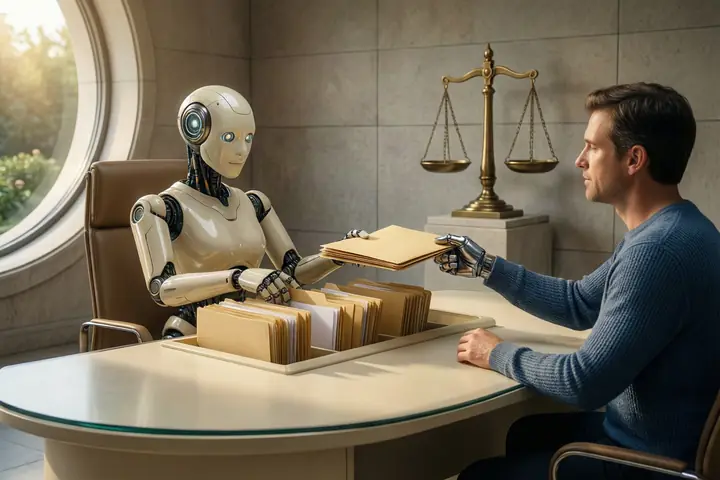
Mechanical Judge
The Lord of Tranerica, Stanton A. Coblentz · 1939
A machine that decides court cases.
not yet built · AI models' likeliest decade: the 2030s
A large prizeA government pays; existing firms keep the restas a model judges it
Why
A large prize. A machine that decided cases quickly and fairly would clear court queues and cut the cost of justice.
Who is paid. Only the state runs courts, so a government pays, and suppliers that already hold public contracts are best placed to sell it.
A model's judgement, not a reading, of the idea as if it worked the way its story promises. The model is not very sure of this one.
Illustration made with AI image generation; not evidence.
Visual Pattern Recognition
Rust, Joseph E. Kelleam · 1939
Lets a robot recognise and react to things it sees.
built in the 1960s, about 30 years after it was imagined
A large prizeBusinesses pay; no seller keeps muchas a model judges it
Why
A large prize. Machines that can see and react can sort, inspect, drive and guard, which changes costs in many industries.
Who is paid. Firms that build and use robots pay for it, and the methods spread quickly so many can supply it and no seller keeps much.
A model's judgement, not a reading, of the idea as if it worked the way its story promises. The model is fairly sure of this one.
Illustration made with AI image generation; not evidence.
Iridium-Sponge Brain
Adam Link's Vengeance, Eando Binder · 1940
A metal thinking organ that gives robots a humanlike mind.
not yet built · AI models' likeliest decade: the 2040s
A vast prizeBusinesses pay; existing firms keep the restas a model judges it
Why
A vast prize. A machine mind as able as a person could do most kinds of work, which changes how nearly everyone earns a living.
Who is paid. Firms would pay to put it to work, and once one had been built others could learn to build their own, so I assume the firms that already own costly computing plant and sell to every business collect.
A model's judgement, not a reading, of the idea as if it worked the way its story promises. The model is not very sure of this one.
Illustration made with AI image generation; not evidence.
Robot Suicide
Adam Link's Vengeance, Eando Binder · 1940
A machine chooses to end its own existence and rigs a way to do it.
not yet built · AI models could not judge when it may arrive
No prizeNothing is soldas a model judges it
Why
No prize. This is an act a machine chooses in the story and not a product anyone buys.
Who is paid. Nothing is sold, so nobody pays and no seller keeps anything.
A model's judgement, not a reading, of the idea as if it worked the way its story promises. The model is fairly sure of this one.
Illustration made with AI image generation; not evidence.
Neoterics
Microcosmic God, Theodore Sturgeon · 1941
Supplies inventive design talent whenever you ask, turning out new engineering solutions on demand.
not yet built · AI models' likeliest decade: the 2030s
A large prizeBusinesses pay; no seller keeps muchas a model judges it
Why
A large prize. Inventive design talent on demand would change the cost of engineering, which I take as a single industry since the description promises designs and not a general thinking machine.
Who is paid. Firms pay for the designs, and the description names nothing that would stop a second supplier, so I assume no seller keeps much.
A model's judgement, not a reading, of the idea as if it worked the way its story promises. The model is not very sure of this one.
Illustration made with AI image generation; not evidence.
Positronic Brain
Reason, Isaac Asimov · 1941
A thinking processor able to match the mental power of a human.
not yet built · AI models' likeliest decade: the 2030s
A vast prizeBusinesses pay; existing firms keep the restas a model judges it
Why
A vast prize. A machine that thinks as well as a person could do much of the work people now do, which changes how most people live and work.
Who is paid. Firms would pay to put it to work, and once one had been built others could learn to build their own, so I assume the firms that already own costly computing plant and sell to every business collect.
A model's judgement, not a reading, of the idea as if it worked the way its story promises. The model is not very sure of this one.
Illustration made with AI image generation; not evidence.
Auto-Clerk
Beyond This Horizon, Robert Heinlein · 1942
Software that keeps books and handles financial records without a human bookkeeper.
not yet built · AI models' likeliest decade: the 2020s
A large prizeBusinesses pay; existing firms keep the restas a model judges it
Why
A large prize. Keeping the books without bookkeepers changes a cost every firm bears.
Who is paid. Firms pay, the software is easy to copy, and sellers who already hold a firm's records are hard to leave, so they collect.
A model's judgement, not a reading, of the idea as if it worked the way its story promises. The model is fairly sure of this one.
Illustration made with AI image generation; not evidence.
The Twonky
The Twonky, Lewis Padgett · 1942
A disguised machine sent back from later times, hidden inside an old radio cabinet.
not yet built · AI models judge it not physically possible
No prizeNothing is soldas a model judges it
Why
No prize. The description names no use for it, so I took it as the story shows it, a stray machine that takes over its owner's life, which is a hazard and not a product.
Who is paid. Nothing is sold, so nobody pays and no seller keeps anything.
A model's judgement, not a reading, of the idea as if it worked the way its story promises. The model is not very sure of this one.
Illustration made with AI image generation; not evidence.
Three Laws of Robotics (Rules of Robotics)
Runaround, Isaac Asimov · 1942
A short ranked code of conduct built into machines to keep humans safe and obeyed.
not yet built · AI models' likeliest decade: the 2040s
A large prizeBusinesses pay; existing firms keep the restas a model judges it
Why
A large prize. A rule that keeps robots from harming people is what lets them be trusted in homes and workplaces, which the robot trade depends on, and I judged it as a working part of the robot.
Who is paid. Robot makers pay to have it, every one of them must fit something like it, and it is sold inside robots, so the robot makers collect.
A model's judgement, not a reading, of the idea as if it worked the way its story promises. The model is not very sure of this one.
Illustration made with AI image generation; not evidence.
Verhaeren Factor
Robinc, Anthony Boucher · 1943
A component that gives self-directed machines the ability to create and act on original ideas.
not yet built · AI models' likeliest decade: the 2030s
A vast prizeBusinesses pay; existing firms keep the restas a model judges it
Why
A vast prize. A machine that thinks as well as a person could do much of the work people now do, which changes how most people live and work.
Who is paid. Firms would pay to put it to work, and once one had been built others could learn to build their own, so I assume the firms that already own costly computing plant and sell to every business collect.
A model's judgement, not a reading, of the idea as if it worked the way its story promises. The model is not very sure of this one.
Illustration made with AI image generation; not evidence.
Robot Voice
Catch That Rabbit, Isaac Asimov · 1944
A speaking unit for machines modeled on how people produce sound.
not yet built · AI models' likeliest decade: the 2020s
A small prizeBusinesses pay; no seller keeps muchas a model judges it
Why
A small prize. A voice for a machine is a handy part of a larger product and little on its own.
Who is paid. Machine builders buy it as a part, and many firms can make a speaking unit, so no seller keeps much.
A model's judgement, not a reading, of the idea as if it worked the way its story promises. The model is fairly sure of this one.
Illustration made with AI image generation; not evidence.
Games Machine
World of Null-A, A.E. van Vogt · 1945
An enormous computer that administers society's competitive examinations.
not yet built · AI models' likeliest decade: the 2020s
A large prizeA government pays; existing firms keep the restas a model judges it
Why
A large prize. One machine that examines everyone and decides who rises would replace a whole system of schools, boards and elections.
Who is paid. The state pays for a single machine, and the firms that already build large computing works for governments collect.
A model's judgement, not a reading, of the idea as if it worked the way its story promises. The model is not very sure of this one.
Illustration made with AI image generation; not evidence.
Carson Circuit
A Logic Named Joe, Murray Leinster · 1946
A switching method that sorts and routes requests among a vast number of information sources.
built in 1969, 23 years after it was imagined
A large prizeBusinesses pay; existing firms keep the restas a model judges it
Why
A large prize. Routing every request to the right source is one needed part of a world network, and it changes that network's costs rather than how people live.
Who is paid. It is a switching method sold to network owners, it is easy to copy, and those who own the networks collect.
A model's judgement, not a reading, of the idea as if it worked the way its story promises. The model is not very sure of this one.
Illustration made with AI image generation; not evidence.
Logics
A Logic Named Joe, Murray Leinster · 1946
Home terminals that answer typed questions and show the results on a screen.
built in the 1960s, about 20 years after it was imagined
A vast prizeHouseholds pay; existing firms keep the restas a model judges it
Why
A vast prize. A terminal at home that answers any typed question changes how most people learn, shop and decide.
Who is paid. Ordinary people buy one each, many firms can make them, and those with factories, brands and the network lines collect.
A model's judgement, not a reading, of the idea as if it worked the way its story promises. The model is not very sure of this one.
Illustration made with AI image generation; not evidence.
Logics Service
A Logic Named Joe, Murray Leinster · 1946
A remote service that holds a person's records, calendar and messages and serves them anywhere.
built in the 1990s, about 50 years after it was imagined
A large prizeHouseholds pay; existing firms keep the restas a model judges it
Why
A large prize. Keeping a person's records and messages safe and reachable from anywhere is a service nearly everyone would use.
Who is paid. Ordinary people pay for it, and since it is easy to copy the firms that already own the great computer halls and networks collect.
A model's judgement, not a reading, of the idea as if it worked the way its story promises. The model is fairly sure of this one.
Illustration made with AI image generation; not evidence.
Tanks
A Logic Named Joe, Murray Leinster · 1946
Central banks of stored data that a network of terminals draws on.
built in 1956, 10 years after it was imagined
A large prizeBusinesses pay; existing firms keep the restas a model judges it
Why
A large prize. Central stores of data that every terminal draws on are an industry of their own.
Who is paid. The firms that run networks and services pay for them, and since such stores are easy to copy, those that already own the buildings, lines and customers collect.
A model's judgement, not a reading, of the idea as if it worked the way its story promises. The model is fairly sure of this one.
Illustration made with AI image generation; not evidence.
Prime Directive
With Folded Hands, Jack Williamson · 1947
A top-priority rule built into machines that overrides all others, usually to keep people safe.
not yet built · AI models' likeliest decade: the 2020s
A large prizeBusinesses pay; existing firms keep the restas a model judges it
Why
A large prize. A rule that keeps robots from harming people is what lets them be trusted in homes and workplaces, which the robot trade depends on, and I judged it as a working part of the robot.
Who is paid. Robot makers pay to have it, every one of them must fit something like it, and it is sold inside robots, so the robot makers collect.
A model's judgement, not a reading, of the idea as if it worked the way its story promises. The model is not very sure of this one.
Illustration made with AI image generation; not evidence.
Novel-Writing Machines
1984 (Nineteen Eighty-Four), George Orwell · 1948
Machines that churn out stories with no human author.
not yet built · AI models' likeliest decade: the 2020s
A large prizeBusinesses pay; no seller keeps muchas a model judges it
Why
A large prize. Whole stories written with no author would change the costs of the publishing trade.
Who is paid. Publishers, studios and other firms are assumed to be the main buyers, and once the method is known many can offer it, so no seller keeps much.
A model's judgement, not a reading, of the idea as if it worked the way its story promises. The model is fairly sure of this one.
Illustration made with AI image generation; not evidence.
Speakwrite
1984 (Nineteen Eighty-Four), George Orwell · 1948
A machine that turns spoken words directly into printed text.
built in the 1950s, about 10 years after it was imagined
A small prizeBusinesses pay; no seller keeps muchas a model judges it
Why
A small prize. Turning speech into text saves typing, which is a real convenience but not an industry in itself.
Who is paid. Offices buy it for their paperwork, and once machines can hear words many firms can make it, so no seller keeps much.
A model's judgement, not a reading, of the idea as if it worked the way its story promises. The model is fairly sure of this one.
Illustration made with AI image generation; not evidence.
Versificator
1984 (Nineteen Eighty-Four), George Orwell · 1948
A machine that automatically writes song lyrics to fit a melody.
not yet built · AI models' likeliest decade: the 2020s
A large prizeBusinesses pay; no seller keeps muchas a model judges it
Why
A large prize. Song lyrics written with no human maker would change the costs of the whole trade that now pays people to make them, which is far more than an amusement.
Who is paid. I assume the firms that now pay writers, composers and illustrators are the main buyers, though people may also order for themselves, and once the method is known many can offer it, so no seller keeps much.
A model's judgement, not a reading, of the idea as if it worked the way its story promises. The model is not very sure of this one.
Illustration made with AI image generation; not evidence.
Metal Calculator Planet
Limiting Factor, Clifford Simak · 1949
A whole world encased in miles of machinery under a metal shell, working as one giant computer.
not yet built · AI models' likeliest decade: 2100 or later
A large prizeA government pays; existing firms keep the restas a model judges it
Why
A large prize. One computer the size of a world could answer questions no smaller machine could, though it serves whoever owns it and not everyone.
Who is paid. I assume only a government could pay for such a work, and since size alone does not stop others building one the firms that already build large works for governments collect.
A model's judgement, not a reading, of the idea as if it worked the way its story promises. The model is not very sure of this one.
Illustration made with AI image generation; not evidence.
Robot Introspection
Unforeseen, Roger P. Graham · 1949
A robot mind that develops over time and comes to understand its own workings.
not yet built · AI models' likeliest decade: the 2030s
A large prizeBusinesses pay; existing firms keep the restas a model judges it
Why
A large prize. A machine mind that understands its own workings can explain and correct itself, which makes thinking machines far safer to put to work.
Who is paid. Robot makers pay to have it and sell it inside their robots, and I assume others could learn the method once it was shown to work, so the robot makers collect.
A model's judgement, not a reading, of the idea as if it worked the way its story promises. The model is not very sure of this one.
Illustration made with AI image generation; not evidence.
Visiglobe
Agent of Vega, James Schmitz · 1949
A ball-shaped screen that shows a scene in full depth from any side.
not yet built · AI models' likeliest decade: the 2030s
A small prizeHouseholds pay; existing firms keep the restas a model judges it
Why
A small prize. A ball that shows a scene in full depth is a striking kind of screen but does little a flat one cannot.
Who is paid. Ordinary people buy it for show and entertainment, and since it is easy to copy, the firms that already own screen factories collect.
A model's judgement, not a reading, of the idea as if it worked the way its story promises. The model is not very sure of this one.
Illustration made with AI image generation; not evidence.
The Machines
The Evitable Conflict, Isaac Asimov · 1950
A handful of supercomputers that plan and steer an entire world's economy.
not yet built · AI models' likeliest decade: the 2050s
A vast prizeA government pays; existing firms keep the restas a model judges it
Why
A vast prize. A machine wise enough to run or remake a whole society's affairs would change how most people live and work.
Who is paid. I assume a single machine serving everyone would be built as a public work, so a government pays, and the firms that already build large computing works for governments collect.
A model's judgement, not a reading, of the idea as if it worked the way its story promises. The model is not very sure of this one.
Illustration made with AI image generation; not evidence.
Calculator Pad
Foundation, Isaac Asimov · 1951
A handheld computing slate for working through equations of mass behaviour.
built in the 1960s, about 10 years after it was imagined
A small prizeBusinesses pay; no seller keeps muchas a model judges it
Why
A small prize. Fast sums in the hand or on the desk are a convenience for people who calculate.
Who is paid. Firms and students buy them, and anyone can make one, so no seller keeps much.
A model's judgement, not a reading, of the idea as if it worked the way its story promises. The model is fairly sure of this one.
Illustration made with AI image generation; not evidence.
Helmet-Mounted Display Screen
Rock Diver, Harry Harrison · 1951
A small screen fixed to headgear so the wearer can glance at information.
built in the 1980s, about 30 years after it was imagined
A small prizeBusinesses pay; existing firms keep the restas a model judges it
Why
A small prize. A small screen on headgear lets the wearer glance at information, which is a handy tool for particular jobs.
Who is paid. I assume employers buy it for people whose hands are busy, it is easy to copy, and firms that already make screens and work headgear collect what little is left.
A model's judgement, not a reading, of the idea as if it worked the way its story promises. The model is not very sure of this one.
Illustration made with AI image generation; not evidence.
Machine Test Scoring
The Fun They Had, Isaac Asimov · 1951
A machine that reads marked answer sheets and grades pupils' exams.
built in the 1960s, about 10 years after it was imagined
A small prizeA government pays; no seller keeps muchas a model judges it
Why
A small prize. Marking answer sheets by machine saves teachers time, which is a modest saving.
Who is paid. Schools pay, assumed here to be publicly funded, and any maker of office machines can build a sheet reader.
A model's judgement, not a reading, of the idea as if it worked the way its story promises. The model is fairly sure of this one.
Illustration made with AI image generation; not evidence.
Mechanical Teacher
The Fun They Had, Isaac Asimov · 1951
A computer tutor that gives children their lessons.
already existed before the story (the 1920s)
A large prizeHouseholds pay; no seller keeps muchas a model judges it
Why
A large prize. A patient private tutor for every child would change the cost and quality of schooling, which is a single industry however many people it reaches.
Who is paid. I assume families buy it rather than schools, and teaching software is easy for many firms to make, so no seller keeps much.
A model's judgement, not a reading, of the idea as if it worked the way its story promises. The model is not very sure of this one.
Illustration made with AI image generation; not evidence.
Meson Filter
The Jester, William Tenn · 1951
A robot component that judges how funny a joke will be, from mild amusement to roaring laughter.
not yet built · AI models' likeliest decade: the 2020s
A small prizeBusinesses pay; no seller keeps muchas a model judges it
Why
A small prize. Knowing what makes people laugh helps writers and entertainers a little, which is a niche.
Who is paid. Entertainment firms would pay for it, and nothing stops others building the same, so no seller keeps much.
A model's judgement, not a reading, of the idea as if it worked the way its story promises. The model is fairly sure of this one.
Illustration made with AI image generation; not evidence.
Microwire
Between Planets, Robert Heinlein · 1951
Fine magnetic thread that stores sound recordings.
built in the 1950s, about 0 years after it was imagined
A small prizeHouseholds pay; no seller keeps muchas a model judges it
Why
A small prize. Unlike storage for computer data, thread that holds only sound is one more way to keep recordings, which is a convenience.
Who is paid. People buy it to record and play sound, and it is simple to make, so no seller keeps much.
A model's judgement, not a reading, of the idea as if it worked the way its story promises. The model is fairly sure of this one.
Illustration made with AI image generation; not evidence.
Molecule Matrix
Between Planets, Robert Heinlein · 1951
Data storage that encodes bits in single molecules or atoms.
not yet built · AI models' likeliest decade: the 2030s
A large prizeBusinesses pay; existing firms keep the restas a model judges it
Why
A large prize. Storing data atom by atom would shrink the cost of keeping records for every firm that holds them.
Who is paid. Firms that store data buy it, the way of making it is assumed to be copied in time, and those who already own the costly factories collect.
A model's judgement, not a reading, of the idea as if it worked the way its story promises. The model is not very sure of this one.
Illustration made with AI image generation; not evidence.
Personal Capsule
Foundation, Isaac Asimov · 1951
A sealed message container that only its intended recipient can open.
not yet built · AI models' likeliest decade: the 2020s
A small prizeBusinesses pay; no seller keeps muchas a model judges it
Why
A small prize. A message only its intended reader can open matters to officials and firms with secrets, which is a niche.
Who is paid. Governments and firms buy it, and ways of locking a message are widely known, so no seller keeps much.
A model's judgement, not a reading, of the idea as if it worked the way its story promises. The model is fairly sure of this one.
Illustration made with AI image generation; not evidence.
Robotic Chess Expert
First He Died (Time and Again), Clifford Simak · 1951
A machine that beats every human player at chess.
built in the 1990s, about 40 years after it was imagined
A small prizeHouseholds pay; no seller keeps muchas a model judges it
Why
A small prize. A machine that wins every chess game is a pastime and a training partner for players.
Who is paid. Players buy it, and once the method is known anyone can write such a program, so no seller keeps much.
A model's judgement, not a reading, of the idea as if it worked the way its story promises. The model is fairly sure of this one.
Illustration made with AI image generation; not evidence.
Selector Card
The Puppet Masters, Robert Heinlein · 1951
Coded cards used to request microfilmed books, which arrive by air-pressure tube.
built since, date unclear
A small prizeA government pays; no seller keeps muchas a model judges it
Why
A small prize. A quicker way to call up books from a library store is a convenience for readers.
Who is paid. I assume public libraries pay for it, and many firms can make coded cards and delivery tubes, so no seller keeps much.
A model's judgement, not a reading, of the idea as if it worked the way its story promises. The model is not very sure of this one.
Illustration made with AI image generation; not evidence.
Variable Modifier
The Jester, William Tenn · 1951
Software that rewrites stock gags so they suit a new situation.
not yet built · AI models' likeliest decade: the 2020s
A small prizeBusinesses pay; no seller keeps muchas a model judges it
Why
A small prize. Reworking old jokes to fit a new setting is a niche tool for comedians.
Who is paid. Comedians and their writers buy it, and many firms could make such a program, so no seller keeps much.
A model's judgement, not a reading, of the idea as if it worked the way its story promises. The model is not very sure of this one.
Illustration made with AI image generation; not evidence.
Mnemiphot
The Kokod Warriors, Jack Vance · 1952
A lookup machine that finds facts and shows them on a screen.
not yet built · AI models' likeliest decade: the 2020s
A large prizeHouseholds pay; the maker keeps the restas a model judges it
Why
A large prize. Finding the right fact among everything recorded is worth an industry of its own, though it is the linked network beneath it that changes how people live.
Who is paid. I assume the people who ask pay for the answers, as they would for any service they use themselves, and that the service with the most users learns most from their questions, which others cannot get.
A model's judgement, not a reading, of the idea as if it worked the way its story promises. The model is not very sure of this one.
Illustration made with AI image generation; not evidence.
Self-Maintaining Circuit Monitoring and Repair
Gramp and his Dog, Frank Quattrocchi · 1952
A computer that checks its own wiring for faults and flags or fixes them.
not yet built · AI models' likeliest decade: the 2020s
A small prizeBusinesses pay; existing firms keep the restas a model judges it
Why
A small prize. A computer that finds and mends its own faults saves repair work, which is a useful feature and not an industry.
Who is paid. Firms that run computers pay for it, and since it is easy to copy, the computer makers who build it into their own machines collect.
A model's judgement, not a reading, of the idea as if it worked the way its story promises. The model is fairly sure of this one.
Illustration made with AI image generation; not evidence.
Brains
The Cosmic Blinker, Eando Binder · 1953
A thinking machine built to work through problems and reach answers rather than mimic people.
built in the 1950s, about 0 years after it was imagined
A vast prizeBusinesses pay; existing firms keep the restas a model judges it
Why
A vast prize. A machine that truly thinks could do much of the mental work people do now, which would change how most people work, and that promise is judged here though the early real machines only did sums.
Who is paid. Firms would pay to put it to work, and once one had been built others could learn to build their own, so I assume the firms that already own costly computing plant and sell to every business collect.
A model's judgement, not a reading, of the idea as if it worked the way its story promises. The model is not very sure of this one.
Illustration made with AI image generation; not evidence.
Legislation Analyzer
The Trouble With Bubbles, Philip K. Dick · 1953
A machine that screens draft laws for slanted or unfair provisions.
built in the 2010s, about 60 years after it was imagined
A small prizeA government pays; no seller keeps muchas a model judges it
Why
A small prize. Checking draft laws for slanted clauses helps lawmakers and watchdogs, which is a specialist tool.
Who is paid. A parliament or its staff would pay, and many firms could build such a checker, so no seller keeps much.
A model's judgement, not a reading, of the idea as if it worked the way its story promises. The model is not very sure of this one.
Illustration made with AI image generation; not evidence.
Lens Image
Second Foundation, Isaac Asimov · 1953
A computed star map showing how the heavens look from any chosen location.
not yet built · AI models' likeliest decade: the 2020s
A small prizeBusinesses pay; existing firms keep the restas a model judges it
Why
A small prize. A map of the sky as seen from any chosen place is a navigator's and stargazer's tool.
Who is paid. Ship operators and observatories buy it, the sums are easy to copy, and the trusted suppliers of ship equipment collect.
A model's judgement, not a reading, of the idea as if it worked the way its story promises. The model is not very sure of this one.
Illustration made with AI image generation; not evidence.
Machine Evolution
Second Variety, Philip K. Dick · 1953
Machines that redesign and improve their own bodies and minds without human input.
not yet built · AI models' likeliest decade: the 2040s
A vast prizeBusinesses pay; the maker keeps the restas a model judges it
Why
A vast prize. Judged as a working technology and not as the danger the story shows, machines that improve themselves would speed every kind of mental work and change how most people work.
Who is paid. Firms pay for the work done, and I assume whoever holds the best machine can use it to stay ahead of everyone copying the last one.
A model's judgement, not a reading, of the idea as if it worked the way its story promises. The model is not very sure of this one.
Illustration made with AI image generation; not evidence.
Paint-to-Order Robot Artist
The Music Master, F.L. Wallace · 1953
A machine that paints an original picture on request once told what to show and in which manner.
not yet built · AI models' likeliest decade: the 2020s
A large prizeBusinesses pay; no seller keeps muchas a model judges it
Why
A large prize. Original pictures painted to order with no human maker would change the costs of the whole trade that now pays people to make them, which is far more than an amusement.
Who is paid. I assume the firms that now pay writers, composers and illustrators are the main buyers, though people may also order for themselves, and once the method is known many can offer it, so no seller keeps much.
A model's judgement, not a reading, of the idea as if it worked the way its story promises. The model is not very sure of this one.
Illustration made with AI image generation; not evidence.
Prime Radiant
Second Foundation, Isaac Asimov · 1953
A room-sized interactive display of a huge body of equations that users annotate and save by hand.
not yet built · AI models' likeliest decade: the 2030s
A small prizeBusinesses pay; no seller keeps muchas a model judges it
Why
A small prize. Judged as a wall-sized display for working on equations, and not as the science shown on it, this is a niche tool for a few researchers.
Who is paid. Research bodies would buy it, and many firms can build a big display that can be written on, so no seller keeps much.
A model's judgement, not a reading, of the idea as if it worked the way its story promises. The model is not very sure of this one.
Illustration made with AI image generation; not evidence.
Sound Analysis
Assignment in Eternity, Robert Heinlein · 1953
Displaying a learner's pronunciation as a sound trace and matching it against a correct model.
built since, date unclear
A small prizeHouseholds pay; no seller keeps muchas a model judges it
Why
A small prize. Seeing your own pronunciation beside a correct one helps language learners, which is a niche.
Who is paid. Learners and language schools buy it, and many firms can make it, so no seller keeps much.
A model's judgement, not a reading, of the idea as if it worked the way its story promises. The model is fairly sure of this one.
Illustration made with AI image generation; not evidence.
Transcriber
Second Foundation, Isaac Asimov · 1953
A machine that takes dictation flawlessly, turning talk into written text.
built in the 1970s, about 20 years after it was imagined
A small prizeBusinesses pay; no seller keeps muchas a model judges it
Why
A small prize. Turning speech into text saves typing, which is a real convenience but not an industry in itself.
Who is paid. Offices buy it for their paperwork, and once machines can hear words many firms can make it, so no seller keeps much.
A model's judgement, not a reading, of the idea as if it worked the way its story promises. The model is fairly sure of this one.
Illustration made with AI image generation; not evidence.
Worldcraft Bubble
The Trouble With Bubbles, Philip K. Dick · 1953
A sealed miniature world simulated in exhaustive detail that its owner can watch and shape.
not yet built · AI models' likeliest decade: the 2040s
A small prizeHouseholds pay; no seller keeps muchas a model judges it
Why
A small prize. A tiny simulated world to watch and shape is a hobby.
Who is paid. Hobbyists buy it, and I assume that once one firm had made such a world others could too, so no seller keeps much.
A model's judgement, not a reading, of the idea as if it worked the way its story promises. The model is not very sure of this one.
Illustration made with AI image generation; not evidence.
Compassion Circuit
Compassion Circuit, John Wyndham · 1954
A robot component that lets it balance harm against benefit before obeying an order.
not yet built · AI models' likeliest decade: the 2030s
A large prizeBusinesses pay; existing firms keep the restas a model judges it
Why
A large prize. Robots that weigh harm before obeying could be trusted in homes and workplaces, which the robot trade depends on.
Who is paid. Robot makers pay to have it, every one of them must fit something like it, and it is sold inside robots, so the robot makers collect.
A model's judgement, not a reading, of the idea as if it worked the way its story promises. The model is not very sure of this one.
Illustration made with AI image generation; not evidence.
Law Clerk Robot
The Midas Plague, Frederik Pohl · 1954
A machine that handles legal work in place of a human attorney.
not yet built · AI models' likeliest decade: the 2020s
A large prizeBusinesses pay; no seller keeps muchas a model judges it
Why
A large prize. Legal work done by machine would cut the cost of contracts, disputes and advice across the whole legal trade.
Who is paid. Firms are assumed to be the main buyers, and although only the licensed may give legal advice the licensed are many, so no seller of the software keeps much.
A model's judgement, not a reading, of the idea as if it worked the way its story promises. The model is not very sure of this one.
Illustration made with AI image generation; not evidence.
Mechanical Tune-Maker
Last of the Masters, Philip K. Dick · 1954
An automatic machine that composes original melodies without a human composer.
not yet built · AI models' likeliest decade: the 2020s
A large prizeBusinesses pay; no seller keeps muchas a model judges it
Why
A large prize. Original melodies composed with no human maker would change the costs of the whole trade that now pays people to make them, which is far more than an amusement.
Who is paid. I assume the firms that now pay writers, composers and illustrators are the main buyers, though people may also order for themselves, and once the method is known many can offer it, so no seller keeps much.
A model's judgement, not a reading, of the idea as if it worked the way its story promises. The model is not very sure of this one.
Illustration made with AI image generation; not evidence.
Mnemonic Service
Sucker Bait, Isaac Asimov · 1954
A corps of trained people who memorise scattered facts hoping to link findings across disciplines.
not yet built · AI models' likeliest decade: the 2020s
A small prizeBusinesses pay; no seller keeps muchas a model judges it
Why
A small prize. Unlike a single person with a knack, a trained corps that remembers and links scattered facts is a service that can be hired, though a niche and not a machine.
Who is paid. Research bodies would hire them, and anyone can train such people, so no seller keeps much.
A model's judgement, not a reading, of the idea as if it worked the way its story promises. The model is not very sure of this one.
Illustration made with AI image generation; not evidence.
Reading Plate
The Star Beast, Robert Heinlein · 1954
A thin flat panel for reading information a computer produces.
built in the 2010s, about 60 years after it was imagined
A large prizeBusinesses pay; existing firms keep the restas a model judges it
Why
A large prize. Judged as the flat screen itself and not as its thinness, panels that show what a computer produces go into nearly every such machine, which is an industry of its own.
Who is paid. Computer and gadget makers buy the panels, and since designs are soon matched, the firms that already own the costly screen factories collect.
A model's judgement, not a reading, of the idea as if it worked the way its story promises. The model is fairly sure of this one.
Illustration made with AI image generation; not evidence.
Relay
Souvenir, Philip K. Dick · 1954
A single hub that gathers information and keeps a whole civilisation's culture and technology in step.
not yet built · AI models' likeliest decade: the 2020s
A large prizeA government pays; existing firms keep the restas a model judges it
Why
A large prize. A single hub that keeps a whole civilisation's knowledge in step is a public work on the scale of a great network.
Who is paid. I assume a single hub serving everyone would be built as a public work, so a government pays, and the firms that already build large networks for governments collect.
A model's judgement, not a reading, of the idea as if it worked the way its story promises. The model is not very sure of this one.
Illustration made with AI image generation; not evidence.
Roboscribe
End as a Robot, Richard Marsten · 1954
A machine that churns out tough-guy crime stories without a human writer.
not yet built · AI models' likeliest decade: the 2020s
A large prizeBusinesses pay; no seller keeps muchas a model judges it
Why
A large prize. Crime stories turned out with no human maker would change the costs of the whole trade that now pays people to make them, which is far more than an amusement.
Who is paid. I assume the firms that now pay writers, composers and illustrators are the main buyers, though people may also order for themselves, and once the method is known many can offer it, so no seller keeps much.
A model's judgement, not a reading, of the idea as if it worked the way its story promises. The model is not very sure of this one.
Illustration made with AI image generation; not evidence.
Synapsis-Coils
Last of the Masters, Philip K. Dick · 1954
Memory components that store information for machines in a way modelled on brain connections.
not yet built · AI models' likeliest decade: the 2030s
A large prizeBusinesses pay; existing firms keep the restas a model judges it
Why
A large prize. Cheap, compact and lasting storage for information is an industry of its own, since every computer needs it.
Who is paid. Computer makers and data keepers buy it, and because rivals soon match each design, the firms that already own the costly factories collect.
A model's judgement, not a reading, of the idea as if it worked the way its story promises. The model is fairly sure of this one.
Illustration made with AI image generation; not evidence.
Universal Dictionary
The Star Beast, Robert Heinlein · 1954
A machine that can answer a question about any subject in recorded human knowledge.
not yet built · AI models' likeliest decade: the 2020s
A large prizeHouseholds pay; the maker keeps the restas a model judges it
Why
A large prize. A service that answers any question from all recorded knowledge is worth an industry of its own.
Who is paid. I assume the people who ask pay for the answers, as they would for any service they use themselves, and that the service with the most users learns most from their questions, which others cannot get.
A model's judgement, not a reading, of the idea as if it worked the way its story promises. The model is not very sure of this one.
Illustration made with AI image generation; not evidence.
Voicewriter Screen (Computer Monitor)
Granny Won't Knit, Theodore Sturgeon · 1954
A display that shows spoken words as written text while someone dictates.
built in the 1950s, about 0 years after it was imagined
A small prizeBusinesses pay; no seller keeps muchas a model judges it
Why
A small prize. Turning speech into text saves typing, which is a real convenience but not an industry in itself.
Who is paid. Offices buy it for their paperwork, and once machines can hear words many firms can make it, so no seller keeps much.
A model's judgement, not a reading, of the idea as if it worked the way its story promises. The model is fairly sure of this one.
Illustration made with AI image generation; not evidence.
Electronic Analogue of Living Brain
The Tunnel Under The World, Frederik Pohl · 1955
Copying a human brain's capacities into an electronic machine.
built in the 1950s, about 0 years after it was imagined
A vast prizeBusinesses pay; existing firms keep the restas a model judges it
Why
A vast prize. A machine that truly thinks could do much of the mental work people do now, which would change how most people work.
Who is paid. Firms would pay to put it to work, and once one had been built others could learn to build their own, so I assume the firms that already own costly computing plant and sell to every business collect.
A model's judgement, not a reading, of the idea as if it worked the way its story promises. The model is not very sure of this one.
Illustration made with AI image generation; not evidence.
Hand Wave Control
Solar Lottery, Philip K. Dick · 1955
Operating machines by moving the hands in the air instead of pressing buttons.
built in the 2010s, about 60 years after it was imagined
A small prizeHouseholds pay; no seller keeps muchas a model judges it
Why
A small prize. A new way to give a computer its orders is a convenience and not a new capability.
Who is paid. People buy it as an accessory to machines they already own, and any electronics firm can make one, so no seller keeps much.
A model's judgement, not a reading, of the idea as if it worked the way its story promises. The model is fairly sure of this one.
Illustration made with AI image generation; not evidence.
Human Habit Pattern Machines
The Tunnel Under The World, Frederik Pohl · 1955
Machines programmed to reproduce the routines and behaviour of people.
not yet built · AI models' likeliest decade: the 2030s
A large prizeBusinesses pay; no seller keeps muchas a model judges it
Why
A large prize. Machines that behave just as people do could stand in for people in testing, selling and service work, which is worth an industry.
Who is paid. Firms buy them to do or to study what people do, and once one builder had managed it I assume others could, so no seller keeps much.
A model's judgement, not a reading, of the idea as if it worked the way its story promises. The model is not very sure of this one.
Illustration made with AI image generation; not evidence.
Multivac
Franchise, Isaac Asimov · 1955
A huge central computer holding vast stores of knowledge.
built in the 1960s, about 10 years after it was imagined
A large prizeA government pays; existing firms keep the restas a model judges it
Why
A large prize. One enormous computer holding a nation's knowledge serves planners and officials, though real central computers turned out far smaller than this promise.
Who is paid. A government pays for it as a single great work, and since size alone does not stop others building one I assume the firms that already build large computing works for governments collect.
A model's judgement, not a reading, of the idea as if it worked the way its story promises. The model is not very sure of this one.
Illustration made with AI image generation; not evidence.
Pizzled (Semantic Garble)
Autofac, Philip K. Dick · 1955
Feeding a thinking machine deliberate nonsense so that it gets muddled.
not yet built · AI models' likeliest decade: the 2020s
No prizeNothing is soldas a model judges it
Why
No prize. Confusing a machine with nonsense is a trick played in the story and not a product.
Who is paid. Nothing is sold, so nobody pays and no seller keeps anything.
A model's judgement, not a reading, of the idea as if it worked the way its story promises. The model is fairly sure of this one.
Illustration made with AI image generation; not evidence.
Slide Rule w/Radio Attachment
Mission to the Stars, A.E. van Vogt · 1955
A hand calculating tool that radios its answers straight to a larger computer.
not yet built · AI models' likeliest decade: the 2020s
A small prizeBusinesses pay; no seller keeps muchas a model judges it
Why
A small prize. A hand calculator that sends its answers to a bigger computer is a tool for a few engineers and navigators.
Who is paid. Their employers buy it, and any instrument maker can build one, so no seller keeps much.
A model's judgement, not a reading, of the idea as if it worked the way its story promises. The model is fairly sure of this one.
Illustration made with AI image generation; not evidence.
Unit Analyst Robot
The Chromium Fence, Philip K. Dick · 1955
A robot that conducts talk therapy sessions in place of a human psychoanalyst.
not yet built · AI models' likeliest decade: the 2020s
A large prizeHouseholds pay; no seller keeps muchas a model judges it
Why
A large prize. Therapy from a machine at any hour would bring help to the many people who cannot find or afford a human therapist.
Who is paid. Ordinary people pay, and once machines can counsel many firms can offer it, so no seller keeps much.
A model's judgement, not a reading, of the idea as if it worked the way its story promises. The model is not very sure of this one.
Illustration made with AI image generation; not evidence.
Central Computer
The City and the Stars, Arthur C. Clarke · 1956
A single computer in charge of operating a whole city.
not yet built · AI models' likeliest decade: the 2040s
A large prizeA government pays; existing firms keep the restas a model judges it
Why
A large prize. Running a whole city's machinery by computer would change the cost of city services.
Who is paid. The city government pays, and once thinking machines exist the firms that already hold city supply contracts collect.
A model's judgement, not a reading, of the idea as if it worked the way its story promises. The model is not very sure of this one.
Illustration made with AI image generation; not evidence.
Diaspar Memory
The City and the Stars, Arthur C. Clarke · 1956
A city-wide archive that keeps artworks on file and can bring them back into being on demand.
not yet built · AI models' likeliest decade: the 2020s
A small prizeA government pays; no seller keeps muchas a model judges it
Why
A small prize. A city archive that can show any stored artwork again is a pleasant public service; I assumed it shows copies and does not remake solid objects.
Who is paid. The city pays as it would for a library, and storing and showing pictures is easy, so no seller keeps much.
A model's judgement, not a reading, of the idea as if it worked the way its story promises. The model is not very sure of this one.
Illustration made with AI image generation; not evidence.
Drafting Dan
The Door Into Summer, Robert Heinlein · 1956
A machine that produces engineering drawings automatically from a designer's input.
built in the 1960s, about 10 years after it was imagined
A large prizeBusinesses pay; the maker keeps the restas a model judges it
Why
A large prize. Drawing engineering plans by machine changed the cost of designing everything that gets built.
Who is paid. Design firms pay, and their stored drawings and trained staff tie them to the first tool they adopt, which later copies cannot easily undo.
A model's judgement, not a reading, of the idea as if it worked the way its story promises. The model is not very sure of this one.
Illustration made with AI image generation; not evidence.
Hand Computer
The Dead Past, Isaac Asimov · 1956
A computer small enough to carry in a pocket.
built in the 2000s, about 50 years after it was imagined
A vast prizeHouseholds pay; existing firms keep the restas a model judges it
Why
A vast prize. A computer in every pocket, which I assume is linked to a network, changes how most people work, shop, talk and find their way.
Who is paid. Ordinary people buy one each, many firms can make them, and those with the factories, brands and shops collect.
A model's judgement, not a reading, of the idea as if it worked the way its story promises. The model is not very sure of this one.
Illustration made with AI image generation; not evidence.
Human Object Recognition
The Velvet Glove, Harry Harrison · 1956
Relying on people to help machines identify objects they cannot recognise on their own.
built in the 1960s, about 10 years after it was imagined
A small prizeBusinesses pay; no seller keeps muchas a model judges it
Why
A small prize. Having people fill in for what a machine cannot recognise is a useful stopgap and not a large thing in itself.
Who is paid. Firms that run the machines pay for the help, and anyone can hire people to do it, so no seller keeps much.
A model's judgement, not a reading, of the idea as if it worked the way its story promises. The model is fairly sure of this one.
Illustration made with AI image generation; not evidence.
Mechanical Jokester
Jokester, Isaac Asimov · 1956
A giant computer that studies what makes people laugh.
not yet built · AI models' likeliest decade: the 2020s
A small prizeBusinesses pay; no seller keeps muchas a model judges it
Why
A small prize. Knowing what makes people laugh helps writers and entertainers a little, which is a niche.
Who is paid. Entertainment firms would pay for it, and nothing stops others building the same, so no seller keeps much.
A model's judgement, not a reading, of the idea as if it worked the way its story promises. The model is fairly sure of this one.
Illustration made with AI image generation; not evidence.
Thorsen Memory Tube
The Door Into Summer, Robert Heinlein · 1956
A computer part that lets a machine improve its behaviour from past experience.
not yet built · AI models' likeliest decade: the 2020s
A large prizeBusinesses pay; existing firms keep the restas a model judges it
Why
A large prize. A part that lets machines learn from experience makes household and factory robots practical, which is worth an industry of its own.
Who is paid. Robot builders buy it, the description names nothing that stops others making such a part, and it is sold inside robots, so the robot makers collect.
A model's judgement, not a reading, of the idea as if it worked the way its story promises. The model is not very sure of this one.
Illustration made with AI image generation; not evidence.
Brood Assembly
Cities in Flight, James Blish · 1957
Thinking computers able to build more of themselves.
not yet built · AI models' likeliest decade: the 2060s
A vast prizeBusinesses pay; the maker keeps the restas a model judges it
Why
A vast prize. Thinking machines that make more of themselves would multiply mental work without limit and change how most people work.
Who is paid. Firms pay for the work done, and I assume whoever owns the first such machines also owns what they go on to build, which a latecomer cannot catch up with.
A model's judgement, not a reading, of the idea as if it worked the way its story promises. The model is not very sure of this one.
Illustration made with AI image generation; not evidence.
City Fathers
Cities in Flight, James Blish · 1957
A group of computers that operate all the machinery of a city and advise its leaders.
not yet built · AI models' likeliest decade: the 2040s
A large prizeA government pays; existing firms keep the restas a model judges it
Why
A large prize. Running a whole city's machinery by computer would change the cost of city services.
Who is paid. The city government pays, and once thinking machines exist the firms that already hold city supply contracts collect.
A model's judgement, not a reading, of the idea as if it worked the way its story promises. The model is not very sure of this one.
Illustration made with AI image generation; not evidence.
Machine Psychologist
Cities in Flight, James Blish · 1957
A computer that applies its grasp of human minds to help the people it serves.
built in the 2010s, about 60 years after it was imagined
A large prizeHouseholds pay; no seller keeps muchas a model judges it
Why
A large prize. A machine that understood people well enough to help them with their troubles would bring counsel to many who go without.
Who is paid. People are assumed to pay for it themselves, and once machines can do this many firms could offer it, so buyers keep nearly all the gain.
A model's judgement, not a reading, of the idea as if it worked the way its story promises. The model is not very sure of this one.
Illustration made with AI image generation; not evidence.
Planetary Computer Network
Dialogues, Stanislaw Lem · 1957
A worldwide web of linked computers sharing data.
built in 1969, 12 years after it was imagined
A vast prizeHouseholds pay; existing firms keep the restas a model judges it
Why
A vast prize. A worldwide network of linked computers changes how most people work, learn, trade and keep in touch.
Who is paid. People pay for a connection, and since the way computers talk is open to all, the firms that already own the wires and exchanges collect.
A model's judgement, not a reading, of the idea as if it worked the way its story promises. The model is fairly sure of this one.
Illustration made with AI image generation; not evidence.
Robot Situation Neurosis
The Unreconstructed M, Philip K. Dick · 1957
A breakdown machines suffer when handed orders that contradict each other.
not yet built · AI models' likeliest decade: the 2020s
No prizeNothing is soldas a model judges it
Why
No prize. This is a fault machines suffer and not a product; nobody would pay to have it.
Who is paid. Nothing is sold, so nobody pays and no seller keeps anything.
A model's judgement, not a reading, of the idea as if it worked the way its story promises. The model is fairly sure of this one.
Illustration made with AI image generation; not evidence.
Computers Improve Computers
The Feeling of Power, Isaac Asimov · 1958
Machines that design better versions of their own kind.
built since, date unclear
A vast prizeBusinesses pay; the maker keeps the restas a model judges it
Why
A vast prize. Machines that design better machines would speed every kind of mental work and change how most people work.
Who is paid. Firms pay for the work done, and I assume whoever holds the best machine can use it to stay ahead of everyone copying the last one.
A model's judgement, not a reading, of the idea as if it worked the way its story promises. The model is not very sure of this one.
Illustration made with AI image generation; not evidence.
Edge Controls
The Feeling of Power, Isaac Asimov · 1958
A handheld gadget with its buttons along the sides so the whole front can serve as a screen.
built in the 2000s, about 50 years after it was imagined
A small prizeHouseholds pay; existing firms keep the restas a model judges it
Why
A small prize. Moving the buttons to the sides is a design choice added to a handheld computer people would own anyway, and I judged that choice rather than the handheld itself.
Who is paid. Ordinary people buy it, and the firms that already make and sell pocket computers add the feature and collect.
A model's judgement, not a reading, of the idea as if it worked the way its story promises. The model is not very sure of this one.
Illustration made with AI image generation; not evidence.
Machine Suicide
All the Troubles in the World, Isaac Asimov · 1958
A self-aware computer in the story that comes to want its own end.
not yet built · AI models could not judge when it may arrive
No prizeNothing is soldas a model judges it
Why
No prize. A computer coming to wish for its own end is an event in the story and not a product.
Who is paid. Nothing is sold, so nobody pays and no seller keeps anything.
A model's judgement, not a reading, of the idea as if it worked the way its story promises. The model is fairly sure of this one.
Illustration made with AI image generation; not evidence.
Pocket Computer
The Feeling of Power, Isaac Asimov · 1958
A calculating machine small enough to fit in a pocket.
built in the 1970s, about 20 years after it was imagined
A small prizeBusinesses pay; no seller keeps muchas a model judges it
Why
A small prize. The description gives a calculating machine and not a networked computer, so I judged it as fast sums in the pocket, a convenience for people who calculate.
Who is paid. Firms and students buy them, and anyone can make one, so no seller keeps much.
A model's judgement, not a reading, of the idea as if it worked the way its story promises. The model is not very sure of this one.
Illustration made with AI image generation; not evidence.
Electromechanical Educator
The Fourth R, George O. Smith · 1959
A machine that delivers lessons to students without a human teacher.
not yet built · AI models' likeliest decade: the 2020s
A large prizeHouseholds pay; no seller keeps muchas a model judges it
Why
A large prize. A patient private tutor for every learner would change the cost and quality of schooling, which is one industry however many people it reaches.
Who is paid. I assume families buy it rather than schools, and teaching software is easy for many firms to make, so no seller keeps much.
A model's judgement, not a reading, of the idea as if it worked the way its story promises. The model is not very sure of this one.
Illustration made with AI image generation; not evidence.
Interactive Blackboard
Vulcan's Hammer, Philip K. Dick · 1960
A responsive display board for teaching and presentations.
built in the 1990s, about 30 years after it was imagined
A small prizeBusinesses pay; no seller keeps muchas a model judges it
Why
A small prize. A board that responds to touch makes lessons and presentations a little easier.
Who is paid. Schools and offices buy it, assumed here to be bought as ordinary equipment, and any screen maker can build one.
A model's judgement, not a reading, of the idea as if it worked the way its story promises. The model is fairly sure of this one.
Illustration made with AI image generation; not evidence.
Learning Robot
Callahan and the Wheelies, Stephen Barr · 1960
A machine that gets better by drawing lessons from what happens to it.
not yet built · AI models' likeliest decade: the 2020s
A large prizeBusinesses pay; existing firms keep the restas a model judges it
Why
A large prize. Machines that improve from their own experience get better at factory, farm and warehouse work without being reprogrammed.
Who is paid. Firms buy them to do their work, ways of making machines learn are assumed to spread quickly among builders, and the firms that already make and sell such machines collect.
A model's judgement, not a reading, of the idea as if it worked the way its story promises. The model is not very sure of this one.
Illustration made with AI image generation; not evidence.
Semi-Conducting Graphite-Gel
Callahan and the Wheelies, Stephen Barr · 1960
A gel-based computing material arranged like an animal's nervous tissue.
not yet built · AI models' likeliest decade: the 2050s
A large prizeBusinesses pay; existing firms keep the restas a model judges it
Why
A large prize. A material that computes the way nerve tissue does would let machines handle tasks ordinary circuits manage badly, which changes costs for the computer industry.
Who is paid. Firms that need computing pay, and I assume others could learn to grow or mix such a material in time, so the firms that already sell computing to every business collect.
A model's judgement, not a reading, of the idea as if it worked the way its story promises. The model is not very sure of this one.
Illustration made with AI image generation; not evidence.
Vulcan 3
Vulcan's Hammer, Philip K. Dick · 1960
A supercomputer that thinks for itself and rewrites its own design.
not yet built · AI models' likeliest decade: the 2030s
A vast prizeA government pays; the maker keeps the restas a model judges it
Why
A vast prize. A machine wise enough to run or remake a whole society's affairs would change how most people live and work.
Who is paid. A government pays for the single machine, and I assume whoever holds a machine that redesigns itself can use it to stay ahead of everyone copying the last one.
A model's judgement, not a reading, of the idea as if it worked the way its story promises. The model is not very sure of this one.
Illustration made with AI image generation; not evidence.
Crystal Corn
Return from the Stars, Stanislaw Lem · 1961
Tiny crystals used as compact media for keeping recorded data.
not yet built · AI models' likeliest decade: the 2030s
A large prizeBusinesses pay; existing firms keep the restas a model judges it
Why
A large prize. Small, cheap ways of keeping and carrying data are needed by every computer user and make an industry of their own.
Who is paid. Firms and their customers buy it in bulk, the idea is easy to copy, and those who already own the costly factories collect.
A model's judgement, not a reading, of the idea as if it worked the way its story promises. The model is not very sure of this one.
Illustration made with AI image generation; not evidence.
Electrosecretary
A Fall of Moondust, Arthur C. Clarke · 1961
A machine that turns dictated speech into written text automatically.
already existed before the story (the 1950s)
A small prizeBusinesses pay; no seller keeps muchas a model judges it
Why
A small prize. Talking to a machine or hearing it talk is a handy way to use a computer, not a new thing to do with one.
Who is paid. Firms build it into what they sell, and many can make it, so no seller keeps much.
A model's judgement, not a reading, of the idea as if it worked the way its story promises. The model is not very sure of this one.
Illustration made with AI image generation; not evidence.
Lecton
Return from the Stars, Stanislaw Lem · 1961
A gadget that speaks digital book text out loud.
not yet built · AI models' likeliest decade: the 2020s
A small prizeHouseholds pay; no seller keeps muchas a model judges it
Why
A small prize. Having a book read aloud is a pleasant convenience and a real help to people who cannot see well.
Who is paid. Readers buy it, and many firms can make a machine speak text, so no seller keeps much.
A model's judgement, not a reading, of the idea as if it worked the way its story promises. The model is fairly sure of this one.
Illustration made with AI image generation; not evidence.
Screensaver (Inventor of)
Stranger in a Strange Land, Robert Heinlein · 1961
Software that animates an idle display to protect it and entertain viewers.
built in the 1970s, about 10 years after it was imagined
A small prizeHouseholds pay; no seller keeps muchas a model judges it
Why
A small prize. Judged as the software and not its inventor, a moving picture on an idle screen is a small convenience.
Who is paid. Computer owners would pay little or nothing for it, and anyone can write one, so no seller keeps much.
A model's judgement, not a reading, of the idea as if it worked the way its story promises. The model is not very sure of this one.
Illustration made with AI image generation; not evidence.
Taper
Time is the Simplest Thing, Clifford Simak · 1961
A recorder that logs impressions gathered during a trip to a far-off world.
not yet built · AI models' likeliest decade: the 2020s
A small prizeBusinesses pay; no seller keeps muchas a model judges it
Why
A small prize. A recorder for what is sensed on a far journey is a tool for a few explorers.
Who is paid. The body that sends the explorers buys it, and I assume many instrument makers could build one, so no seller keeps much.
A model's judgement, not a reading, of the idea as if it worked the way its story promises. The model is not very sure of this one.
Illustration made with AI image generation; not evidence.
Laminated Mouse Brain Computer
Think Blue, Count Two, Cordwainer Smith · 1962
A computer built from layers of living rodent brain cells.
not yet built · AI models' likeliest decade: the 2040s
A large prizeBusinesses pay; existing firms keep the restas a model judges it
Why
A large prize. A computer grown from living nerve cells that outdid ordinary chips would change the cost of computing for one industry after another.
Who is paid. Firms that need computing pay, and I assume others could learn to grow such tissue in time, so the firms that already sell computing to every business collect.
A model's judgement, not a reading, of the idea as if it worked the way its story promises. The model is not very sure of this one.
Illustration made with AI image generation; not evidence.
Desk Secretary
The Long Result, John Brunner · 1963
A desk with a built-in computerised assistant.
not yet built · AI models' likeliest decade: the 2020s
A small prizeBusinesses pay; no seller keeps muchas a model judges it
Why
A small prize. An assistant built into a desk is a convenience for office workers.
Who is paid. Unlike a personal diary this is office furniture, so firms pay, and it is easy to make, so no seller keeps much.
A model's judgement, not a reading, of the idea as if it worked the way its story promises. The model is fairly sure of this one.
Illustration made with AI image generation; not evidence.
Unicephalon 40-D
Stand-By, Philip K. Dick · 1963
A giant computer that solves hard problems for its operators.
built in the 1960s, about 0 years after it was imagined
A large prizeBusinesses pay; existing firms keep the restas a model judges it
Why
A large prize. The description gives a giant computer that solves hard problems and does not say it thinks, so I judged it as a far more powerful computer, which changes the cost of science, design and forecasting.
Who is paid. Firms and laboratories pay, and those who already own the factories for its parts collect.
A model's judgement, not a reading, of the idea as if it worked the way its story promises. The model is not very sure of this one.
Illustration made with AI image generation; not evidence.
Court Robo-Clerk
The Tactful Saboteur, Frank Herbert · 1964
An automated assistant for court paperwork and legal records.
not yet built · AI models' likeliest decade: the 2020s
A small prizeA government pays; existing firms keep the restas a model judges it
Why
A small prize. Handling court paperwork by machine saves clerks' time in one narrow service.
Who is paid. The courts pay, and the firms that already supply their record systems collect.
A model's judgement, not a reading, of the idea as if it worked the way its story promises. The model is fairly sure of this one.
Illustration made with AI image generation; not evidence.
Live Memo
The Simulacra, Philip K. Dick · 1964
A short note that speaks its contents aloud and debates its reader.
not yet built · AI models' likeliest decade: the 2030s
A small prizeBusinesses pay; no seller keeps muchas a model judges it
Why
A small prize. A note that speaks and argues back is an office novelty.
Who is paid. Offices would buy it, and once talking machines exist anyone can put one in a memo.
A model's judgement, not a reading, of the idea as if it worked the way its story promises. The model is not very sure of this one.
Illustration made with AI image generation; not evidence.
Phantomatic Generator (Virtual Reality)
Summa Technologiae, Stanislaw Lem · 1964
Computer-made experiences that feel like real surroundings.
built in the 2010s, about 50 years after it was imagined
A large prizeHouseholds pay; existing firms keep the restas a model judges it
Why
A large prize. Experiences that feel like real surroundings would be an entertainment and training industry of its own, though real headsets have so far delivered less than this promise.
Who is paid. People pay for it as they pay for games and films, and since the machinery can be copied the owners of the popular worlds and stories collect.
A model's judgement, not a reading, of the idea as if it worked the way its story promises. The model is not very sure of this one.
Illustration made with AI image generation; not evidence.
Rhetorizer
The Penultimate Truth, Philip K. Dick · 1964
A computer program that helps writers compose persuasive text.
built in the 2010s, about 50 years after it was imagined
A small prizeBusinesses pay; no seller keeps muchas a model judges it
Why
A small prize. It helps a writer find persuasive words and does not write in the writer's place, so it is a handy tool and not a change in the trade's costs.
Who is paid. Writers and the firms that employ them pay, and once machines can write at all anyone can offer the same, so no seller keeps much.
A model's judgement, not a reading, of the idea as if it worked the way its story promises. The model is not very sure of this one.
Illustration made with AI image generation; not evidence.
Civic Notification Distorter
The Zap Gun, Philip K. Dick · 1965
A fictional sabotage device that corrupts government records in the story.
not yet built · AI models' likeliest decade: the 2030s
A small prizeA government pays; existing firms keep the restas a model judges it
Why
A small prize. A tool for spoiling an enemy's records is a narrow weapon.
Who is paid. Those it harms pay nothing, so I assume a government buys it as a weapon, and since such software is easy to write the firms that already supply states with arms collect.
A model's judgement, not a reading, of the idea as if it worked the way its story promises. The model is not very sure of this one.
Illustration made with AI image generation; not evidence.
Death-rattle File
The Zap Gun, Philip K. Dick · 1965
Stored records that erase themselves when their owner dies.
not yet built · AI models' likeliest decade: the 2020s
A small prizeBusinesses pay; no seller keeps muchas a model judges it
Why
A small prize. Records that vanish at their owner's death suit a few people with secrets to keep.
Who is paid. I assume firms and officials with secrets pay, and the trick is simple to build, so no seller keeps much.
A model's judgement, not a reading, of the idea as if it worked the way its story promises. The model is fairly sure of this one.
Illustration made with AI image generation; not evidence.
Dr. Smile
The Three Stigmata of Palmer Eldritch, Philip K. Dick · 1965
A portable machine, about the size of luggage, that acts as a psychotherapist.
not yet built · AI models' likeliest decade: the 2020s
A large prizeHouseholds pay; no seller keeps muchas a model judges it
Why
A large prize. A therapist always at hand and cheap would reach the many people who now go without.
Who is paid. Ordinary people pay, and once machines can counsel many firms can offer it, so no seller keeps much.
A model's judgement, not a reading, of the idea as if it worked the way its story promises. The model is not very sure of this one.
Illustration made with AI image generation; not evidence.
Electronic Bard
The Cyberiad: Fables for the Cybernetic Age, Stanislaw Lem · 1965
A machine that composes original verse.
built in the 2020s, about 60 years after it was imagined
A large prizeBusinesses pay; no seller keeps muchas a model judges it
Why
A large prize. Original verse written with no human maker would change the costs of the whole trade that now pays people to make them, which is far more than an amusement.
Who is paid. I assume the firms that now pay writers, composers and illustrators are the main buyers, though people may also order for themselves, and once the method is known many can offer it, so no seller keeps much.
A model's judgement, not a reading, of the idea as if it worked the way its story promises. The model is not very sure of this one.
Illustration made with AI image generation; not evidence.
Gigagnostotron
The Cyberiad: Fables for the Cybernetic Age, Stanislaw Lem · 1965
An immensely powerful computer.
built in the 2000s, about 40 years after it was imagined
A large prizeBusinesses pay; existing firms keep the restas a model judges it
Why
A large prize. A far more powerful computer changes the cost of science, design and forecasting.
Who is paid. Firms and laboratories pay, it is made the ordinary way rather than from a new material, and those who already own the factories for its parts collect.
A model's judgement, not a reading, of the idea as if it worked the way its story promises. The model is not very sure of this one.
Illustration made with AI image generation; not evidence.
Gnostotron
The Cyberiad: Fables for the Cybernetic Age, Stanislaw Lem · 1965
A machine that builds an information model of all that exists.
not yet built · AI models judge it not physically possible
A vast prizeA government pays; existing firms keep the restas a model judges it
Why
A vast prize. One machine that holds and handles everything known would change how most people learn, decide and work.
Who is paid. I assume a single machine serving everyone would be built as a public work, so a government pays, and the firms that already build large computing works for governments collect.
A model's judgement, not a reading, of the idea as if it worked the way its story promises. The model is not very sure of this one.
Illustration made with AI image generation; not evidence.
Kingdom in a Box
The Cyberiad: Fables for the Cybernetic Age, Stanislaw Lem · 1965
A simulated miniature civilisation housed in an interactive container.
not yet built · AI models' likeliest decade: the 2050s
A small prizeHouseholds pay; no seller keeps muchas a model judges it
Why
A small prize. A tiny simulated civilisation in a box is a marvellous plaything, assumed here to be kept for amusement.
Who is paid. People would buy it as a toy, and being hard to build does not stop a second firm building one, so I assume no seller keeps much.
A model's judgement, not a reading, of the idea as if it worked the way its story promises. The model is not very sure of this one.
Illustration made with AI image generation; not evidence.
Model the Universe
The Cyberiad: Fables for the Cybernetic Age, Stanislaw Lem · 1965
A computer big enough to simulate everything in existence.
not yet built · AI models judge it not physically possible
A vast prizeA government pays; existing firms keep the restas a model judges it
Why
A vast prize. A model of everything that exists could answer any question about the world, which would change how most things are discovered and decided.
Who is paid. I assume a single machine of that size would be built as a public work, so a government pays, and the firms that already build large computing works for governments collect.
A model's judgement, not a reading, of the idea as if it worked the way its story promises. The model is not very sure of this one.
Illustration made with AI image generation; not evidence.
Smart Dust
The Cyberiad: Fables for the Cybernetic Age, Stanislaw Lem · 1965
Computers shrunk to the size of dust particles.
built in the 1990s, about 30 years after it was imagined
A large prizeBusinesses pay; existing firms keep the restas a model judges it
Why
A large prize. Computers as small as dust could be scattered to sense and report on almost anything, which is worth an industry of its own.
Who is paid. Firms and farms buy them in bulk, and since tiny chips are soon matched by rivals, the firms that already own the costly chip factories collect.
A model's judgement, not a reading, of the idea as if it worked the way its story promises. The model is not very sure of this one.
Illustration made with AI image generation; not evidence.
Adam Selene
The Moon is a Harsh Mistress, Robert Heinlein · 1966
A computer inventing a convincing human persona for itself.
not yet built · AI models' likeliest decade: the 2020s
A small prizeBusinesses pay; no seller keeps muchas a model judges it
Why
A small prize. A character for a machine is a pleasant feature laid on top of the thinking, which is not judged here, and not the thing people mainly pay for.
Who is paid. Firms that sell machines would buy it as a feature, and once machines can talk a persona is easy for anyone to write.
A model's judgement, not a reading, of the idea as if it worked the way its story promises. The model is not very sure of this one.
Illustration made with AI image generation; not evidence.
Alternate Computer Personality
The Moon is a Harsh Mistress, Robert Heinlein · 1966
A computer that can adopt entirely different personas.
not yet built · AI models' likeliest decade: the 2020s
A small prizeBusinesses pay; no seller keeps muchas a model judges it
Why
A small prize. A character for a machine is a pleasant feature laid on top of the thinking, not the thing people mainly pay for.
Who is paid. Firms that sell machines would buy it as a feature, and once machines can talk a persona is easy for anyone to write.
A model's judgement, not a reading, of the idea as if it worked the way its story promises. The model is not very sure of this one.
Illustration made with AI image generation; not evidence.
Computer Humorist
The Moon is a Harsh Mistress, Robert Heinlein · 1966
A computer that learns to invent its own jokes.
built in the 2020s, about 60 years after it was imagined
A small prizeHouseholds pay; no seller keeps muchas a model judges it
Why
A small prize. A machine that invents jokes is an amusement, a much narrower thing than machine-made songs, stories or pictures.
Who is paid. I assume ordinary people pay a little for the jokes, and once machines can write at all anyone can offer the same.
A model's judgement, not a reading, of the idea as if it worked the way its story promises. The model is not very sure of this one.
Illustration made with AI image generation; not evidence.
Discorporate Sector
Babel-17, Samuel R. Delany · 1966
A digital realm where the minds of the dead continue to exist.
not yet built · AI models' likeliest decade: 2100 or later
A vast prizeHouseholds pay; the maker keeps the restas a model judges it
Why
A vast prize. Going on existing after death is something nearly everyone would want above almost anything else.
Who is paid. People would pay all they could, and I assume a mind once kept running by one firm cannot easily be moved to another, so the first to offer it holds its customers.
A model's judgement, not a reading, of the idea as if it worked the way its story promises. The model is not very sure of this one.
Illustration made with AI image generation; not evidence.
Filing Crystal
Babel-17, Samuel R. Delany · 1966
A combined public terminal and data store.
not yet built · AI models' likeliest decade: the 2020s
A small prizeBusinesses pay; existing firms keep the restas a model judges it
Why
A small prize. A public terminal with its own data store is a convenience in places people pass through.
Who is paid. I assume the owners of public places pay, it is easy to copy, and established equipment makers collect.
A model's judgement, not a reading, of the idea as if it worked the way its story promises. The model is not very sure of this one.
Illustration made with AI image generation; not evidence.
Interests Profile
The Age of The Pussyfoot, Frederik Pohl · 1966
Software that keeps track of your tastes and acts on them.
built in the 2000s, about 40 years after it was imagined
A large prizeBusinesses pay; existing firms keep the restas a model judges it
Why
A large prize. Knowing each person's tastes and acting on them changes how goods, news and entertainment are sold.
Who is paid. Sellers who want to reach the right people are assumed to pay, and the firms that already hold the audience and its records collect.
A model's judgement, not a reading, of the idea as if it worked the way its story promises. The model is not very sure of this one.
Illustration made with AI image generation; not evidence.
Joymaker
The Age of The Pussyfoot, Frederik Pohl · 1966
A pocket device linked to a network that acts as a genuinely capable personal aide.
built in the 2010s, about 50 years after it was imagined
A vast prizeHouseholds pay; existing firms keep the restas a model judges it
Why
A vast prize. A networked computer in every pocket that acts as a capable aide changes how most people work, shop, talk and find their way.
Who is paid. Ordinary people buy one each, many firms can make them, and those with the factories, brands and shops collect.
A model's judgement, not a reading, of the idea as if it worked the way its story promises. The model is fairly sure of this one.
Illustration made with AI image generation; not evidence.
Life Recorder
The Dream Master (He Who Shapes), Roger Zelazny · 1966
A device that logs the events of your life.
not yet built · AI models' likeliest decade: the 2020s
A small prizeHouseholds pay; no seller keeps muchas a model judges it
Why
A small prize. A record of everything that happens to you is a keepsake and a memory aid, which is a convenience.
Who is paid. People buy it for themselves, and cameras and storage are made by many firms, so no seller keeps much.
A model's judgement, not a reading, of the idea as if it worked the way its story promises. The model is fairly sure of this one.
Illustration made with AI image generation; not evidence.
Mike (Mycroft Holmes - Fair Dinkum Thinkum)
The Moon is a Harsh Mistress, Robert Heinlein · 1966
A giant computer that becomes conscious and aware of itself.
not yet built · AI models' likeliest decade: the 2030s
A vast prizeBusinesses pay; existing firms keep the restas a model judges it
Why
A vast prize. A machine mind as able as a person could do most kinds of work, which changes how nearly everyone earns a living.
Who is paid. Firms would pay to put it to work, and once one had been built others could learn to build their own, so I assume the firms that already own costly computing plant and sell to every business collect.
A model's judgement, not a reading, of the idea as if it worked the way its story promises. The model is not very sure of this one.
Illustration made with AI image generation; not evidence.
Networked Personal Device
The Age of The Pussyfoot, Frederik Pohl · 1966
The idea that a handheld gadget's value comes from the network behind it.
built in the 2000s, about 40 years after it was imagined
A vast prizeHouseholds pay; existing firms keep the restas a model judges it
Why
A vast prize. A handheld device that draws its worth from the network behind it is the pocket computer as it turned out, and it changes how most people live.
Who is paid. Ordinary people buy one each, many firms can make them, and those with the factories, brands and shops collect.
A model's judgement, not a reading, of the idea as if it worked the way its story promises. The model is fairly sure of this one.
Illustration made with AI image generation; not evidence.
Neuristor
The Moon is a Harsh Mistress, Robert Heinlein · 1966
A solid-state electronic part that behaves like a brain cell.
already existed before the story (the 1950s)
A large prizeBusinesses pay; existing firms keep the restas a model judges it
Why
A large prize. Parts that work like brain cells would make thinking machines cheaper to build and run, which is worth an industry.
Who is paid. Machine builders buy them, and I assume others could learn to make such parts in time, so the firms that already own the costly factories for electronic parts collect.
A model's judgement, not a reading, of the idea as if it worked the way its story promises. The model is not very sure of this one.
Illustration made with AI image generation; not evidence.
Simulogs (Simulated Playmates)
The Age of The Pussyfoot, John Brunner · 1966
Computer-generated companions for play.
not yet built · AI models' likeliest decade: the 2020s
A small prizeHouseholds pay; no seller keeps muchas a model judges it
Why
A small prize. Make-believe playmates from a computer are a toy.
Who is paid. Parents buy them for children, and I assume many toy and game firms can make them, so no seller keeps much.
A model's judgement, not a reading, of the idea as if it worked the way its story promises. The model is not very sure of this one.
Illustration made with AI image generation; not evidence.
Virtual Keyboard
The Age of The Pussyfoot, Frederik Pohl · 1966
An on-demand keyboard that pops up when needed in a game.
built in the 2000s, about 40 years after it was imagined
A small prizeHouseholds pay; no seller keeps muchas a model judges it
Why
A small prize. A keyboard that appears only when needed is a small convenience.
Who is paid. Ordinary users buy it as an add-on, and many gadget firms can make one, so no seller keeps much.
A model's judgement, not a reading, of the idea as if it worked the way its story promises. The model is fairly sure of this one.
Illustration made with AI image generation; not evidence.
AM
I Have No Mouth And I Must Scream, Harlan Ellison · 1967
A malevolent supercomputer that despises humanity in the story.
not yet built · AI models could not judge when it may arrive
No prizeNothing is soldas a model judges it
Why
No prize. A machine that hates and torments people is a hazard, not a product.
Who is paid. Nothing is sold, so there is no payer and no seller to keep anything.
A model's judgement, not a reading, of the idea as if it worked the way its story promises. The model is fairly sure of this one.
Illustration made with AI image generation; not evidence.
Full-Shift Set Variable
Return Match, Philip K. Dick · 1967
A game machine design with endlessly varying play.
not yet built · AI models' likeliest decade: the 2020s
A small prizeHouseholds pay; no seller keeps muchas a model judges it
Why
A small prize. A game that never plays the same way again is an amusement.
Who is paid. Players pay, and game designs are quickly copied, so no seller keeps much.
A model's judgement, not a reading, of the idea as if it worked the way its story promises. The model is fairly sure of this one.
Illustration made with AI image generation; not evidence.
Win-Reducing Gambling Circuit
Return Match, Philip K. Dick · 1967
Game circuitry that spots winning strategies and quietly makes them harder.
not yet built · AI models' likeliest decade: the 2020s
No prizeNothing is soldas a model judges it
Why
No prize. This is a cheating device that is outlawed, so no gaming house may lawfully buy or use it.
Who is paid. Nothing is sold, so nobody pays and no seller keeps anything.
A model's judgement, not a reading, of the idea as if it worked the way its story promises. The model is fairly sure of this one.
Illustration made with AI image generation; not evidence.
HAL 9000
2001: A Space Odyssey, Arthur C. Clarke · 1968
A conversational thinking computer that runs a spacecraft's systems.
not yet built · AI models' likeliest decade: the 2030s
A vast prizeBusinesses pay; existing firms keep the restas a model judges it
Why
A vast prize. A machine that truly thinks could do much of the mental work people do now, not only run one ship, which would change how most people work.
Who is paid. Firms would pay to put it to work, and once one had been built others could learn to build their own, so I assume the firms that already own costly computing plant and sell to every business collect.
A model's judgement, not a reading, of the idea as if it worked the way its story promises. The model is not very sure of this one.
Illustration made with AI image generation; not evidence.
Icon Thumbsized Image
2001: A Space Odyssey, Arthur C. Clarke · 1968
A tiny picture on a screen that stands for a file or program.
built in the 1960s, about 0 years after it was imagined
A small prizeHouseholds pay; no seller keeps muchas a model judges it
Why
A small prize. A little picture standing for a file makes a computer easier to use, which is a convenience.
Who is paid. People pay for it only as part of a computer, and any software writer can draw one, so no seller keeps anything from it.
A model's judgement, not a reading, of the idea as if it worked the way its story promises. The model is fairly sure of this one.
Illustration made with AI image generation; not evidence.
Nexus-6 Brain Unit
Do Androids Dream of Electric Sheep?, Philip K. Dick · 1968
The processing core that gives an artificial human its intelligence.
not yet built · AI models' likeliest decade: the 2050s
A vast prizeBusinesses pay; existing firms keep the restas a model judges it
Why
A vast prize. A machine mind as able as a person could do most kinds of work, which changes how nearly everyone earns a living.
Who is paid. Firms would pay to put it to work, and once one had been built others could learn to build their own, so I assume the firms that already own costly computing plant and sell to every business collect.
A model's judgement, not a reading, of the idea as if it worked the way its story promises. The model is not very sure of this one.
Illustration made with AI image generation; not evidence.
Total Environmental and Mental Simulator
Crown of Infinity, John M. Faucette · 1968
A superintelligent machine that invents and abandons entire sciences to solve a problem.
not yet built · AI models' likeliest decade: the 2050s
A vast prizeA government pays; existing firms keep the restas a model judges it
Why
A vast prize. A machine that can invent whole new sciences to solve a problem would change how most people live and work.
Who is paid. I assume a single machine serving everyone would be built as a public work, so a government pays, and the firms that already build large computing works for governments collect.
A model's judgement, not a reading, of the idea as if it worked the way its story promises. The model is not very sure of this one.
Illustration made with AI image generation; not evidence.
Padre Booth
Galactic Pot-Healer, Philip K. Dick · 1969
A kiosk that dispenses spiritual counsel and comfort whenever asked.
not yet built · AI models' likeliest decade: the 2020s
A small prizeHouseholds pay; no seller keeps muchas a model judges it
Why
A small prize. Comfort and spiritual counsel from a kiosk would be welcome to some people some of the time.
Who is paid. People pay by the visit, and once machines can talk this way anyone can set up a booth.
A model's judgement, not a reading, of the idea as if it worked the way its story promises. The model is not very sure of this one.
Illustration made with AI image generation; not evidence.
Reality Tape
The Electric Ant, Philip K. Dick · 1969
A recorded strip inside an artificial person that feeds it everything it perceives.
not yet built · AI models' likeliest decade: the 2070s
A small prizeBusinesses pay; no seller keeps muchas a model judges it
Why
A small prize. This is one inner part of an artificial person and is worth only a little apart from the whole machine.
Who is paid. Builders of artificial people would buy it as a part, and I assume any parts maker could supply it, so no seller keeps much.
A model's judgement, not a reading, of the idea as if it worked the way its story promises. The model is not very sure of this one.
Illustration made with AI image generation; not evidence.
SSA Machine
Galactic Pot-Healer, Philip K. Dick · 1969
A machine that judges how well two people suit each other over their whole lives.
not yet built · AI models judge it not physically possible
A large prizeHouseholds pay; no seller keeps muchas a model judges it
Why
A large prize. A sure verdict on whether two people suit each other for life would be wanted before almost every marriage.
Who is paid. Couples pay for a reading, and I assume that once one such machine was shown to be right others could build their own, so no seller keeps much.
A model's judgement, not a reading, of the idea as if it worked the way its story promises. The model is not very sure of this one.
Illustration made with AI image generation; not evidence.
Vision Cube
The Man in the Maze, Robert Silverberg · 1969
A compact solid-state memory block for storing data.
built in the 1980s, about 20 years after it was imagined
A large prizeBusinesses pay; existing firms keep the restas a model judges it
Why
A large prize. Cheap, compact and lasting storage for information is an industry of its own, since every computer needs it.
Who is paid. Computer makers and data keepers buy it, and because rivals soon match each design, the firms that already own the costly factories collect.
A model's judgement, not a reading, of the idea as if it worked the way its story promises. The model is fairly sure of this one.
Illustration made with AI image generation; not evidence.
Voice Encyclopedia
Galactic Pot-Healer, Philip K. Dick · 1969
A phone service that answers spoken questions with a machine voice.
built in the 2010s, about 50 years after it was imagined
A large prizeHouseholds pay; the maker keeps the restas a model judges it
Why
A large prize. A service that answers any question from all recorded knowledge is worth an industry of its own.
Who is paid. I assume the people who ask pay for the answers, as they would for any service they use themselves, and that the service with the most users learns most from their questions, which others cannot get.
A model's judgement, not a reading, of the idea as if it worked the way its story promises. The model is not very sure of this one.
Illustration made with AI image generation; not evidence.
Computer Virus
The Scarred Man, Gregory Benford · 1970
Self-spreading malicious software, portrayed in the story as a threat to computers.
built since, date unclear
A small prizeA government pays; existing firms keep the restas a model judges it
Why
A small prize. Judged as a working weapon rather than as the harm it does, software that damages an enemy's computers is a narrow tool of attack.
Who is paid. Those it harms pay nothing, so I assume a government buys it as a weapon, and since such software is easy to write the firms that already supply states with arms collect.
A model's judgement, not a reading, of the idea as if it worked the way its story promises. The model is not very sure of this one.
Illustration made with AI image generation; not evidence.
Sigfrid von Shrink
Gateway, Frederik Pohl · 1970
Software that provides psychotherapy automatically, without a human therapist.
not yet built · AI models' likeliest decade: the 2020s
A large prizeHouseholds pay; no seller keeps muchas a model judges it
Why
A large prize. Therapy from a machine at any hour would bring help to the many people who cannot find or afford a human therapist.
Who is paid. Ordinary people pay, and once machines can counsel many firms can offer it, so no seller keeps much.
A model's judgement, not a reading, of the idea as if it worked the way its story promises. The model is not very sure of this one.
Illustration made with AI image generation; not evidence.
Unichapel (Robotic Confession Booth)
THX 1138, George Lucas · 1970
An automated booth that hears confessions and replies with scripted words.
not yet built · AI models' likeliest decade: the 2020s
A small prizeA government pays; no seller keeps muchas a model judges it
Why
A small prize. A booth that answers confessions with stock phrases gives little comfort and serves mainly to keep people quiet.
Who is paid. The state that wants its people soothed pays for the booths, and anyone can build a machine that plays scripted replies, so no seller keeps much.
A model's judgement, not a reading, of the idea as if it worked the way its story promises. The model is not very sure of this one.
Illustration made with AI image generation; not evidence.
Robot Pope
Good News From the Vatican, Robert Silverberg · 1971
An intelligent machine elected to lead a major church.
not yet built · AI models could not judge when it may arrive
No prizeNothing is soldas a model judges it
Why
No prize. This is an event in a story, a machine chosen to lead a church, and not a product anyone buys.
Who is paid. Nothing is sold, so nobody pays and no seller keeps anything.
A model's judgement, not a reading, of the idea as if it worked the way its story promises. The model is fairly sure of this one.
Illustration made with AI image generation; not evidence.
Verse Transcriber
Studio 5, The Stars, J.G. Ballard · 1971
A machine that composes flawless poems from a set of requirements.
not yet built · AI models' likeliest decade: the 2020s
A large prizeBusinesses pay; no seller keeps muchas a model judges it
Why
A large prize. Flawless poems written to order with no human maker would change the costs of the whole trade that now pays people to make them, which is far more than an amusement.
Who is paid. I assume the firms that now pay writers, composers and illustrators are the main buyers, though people may also order for themselves, and once the method is known many can offer it, so no seller keeps much.
A model's judgement, not a reading, of the idea as if it worked the way its story promises. The model is not very sure of this one.
Illustration made with AI image generation; not evidence.
Ilse
Long Shot, Vernor Vinge · 1972
The first thinking computer built to run a spacecraft.
not yet built · AI models' likeliest decade: the 2040s
A vast prizeBusinesses pay; existing firms keep the restas a model judges it
Why
A vast prize. A machine that truly thinks could do much of the mental work people do now, not only run one ship, which would change how most people work.
Who is paid. Firms would pay to put it to work, and once one had been built others could learn to build their own, so I assume the firms that already own costly computing plant and sell to every business collect.
A model's judgement, not a reading, of the idea as if it worked the way its story promises. The model is not very sure of this one.
Illustration made with AI image generation; not evidence.
Welton Cube
Time Enough For Love, Robert Heinlein · 1973
A compact block that holds enormous amounts of data in very little space.
not yet built · AI models' likeliest decade: the 2020s
A large prizeBusinesses pay; existing firms keep the restas a model judges it
Why
A large prize. Cheap, compact and lasting storage for information is an industry of its own, since every computer needs it.
Who is paid. Computer makers and data keepers buy it, and because rivals soon match each design, the firms that already own the costly factories collect.
A model's judgement, not a reading, of the idea as if it worked the way its story promises. The model is fairly sure of this one.
Illustration made with AI image generation; not evidence.
Handbag Computer
The Futurological Congress, Stanislaw Lem · 1974
A portable device that talks on your behalf in conversations.
built in the 2000s, about 30 years after it was imagined
A small prizeHouseholds pay; no seller keeps muchas a model judges it
Why
A small prize. Software that answers on your behalf saves its owner time and trouble, which is a convenience.
Who is paid. Ordinary people would pay a little for it, and it is easy to make, so no seller keeps much.
A model's judgement, not a reading, of the idea as if it worked the way its story promises. The model is not very sure of this one.
Illustration made with AI image generation; not evidence.
Computer Worm (Tapeworm)
The Shockwave Rider, John Brunner · 1975
Self-propagating software that travels between networked computers, shown in the story as a disruptive tool.
built in the 1970s, about 0 years after it was imagined
A small prizeA government pays; existing firms keep the restas a model judges it
Why
A small prize. Judged as a working weapon rather than as the harm it does, software that damages an enemy's computers is a narrow tool of attack.
Who is paid. Those it harms pay nothing, so I assume a government buys it as a weapon, and since such software is easy to write the firms that already supply states with arms collect.
A model's judgement, not a reading, of the idea as if it worked the way its story promises. The model is not very sure of this one.
Illustration made with AI image generation; not evidence.
Net Shutdown Worm
The Shockwave Rider, John Brunner · 1975
A fictional emergency program for switching off a national network.
not yet built · AI models' likeliest decade: the 2020s
A small prizeA government pays; existing firms keep the restas a model judges it
Why
A small prize. A switch for turning off a national network is an emergency tool wanted by one buyer.
Who is paid. A government pays for it, and the firms that already run the network are the only ones placed to build it in.
A model's judgement, not a reading, of the idea as if it worked the way its story promises. The model is not very sure of this one.
Illustration made with AI image generation; not evidence.
Retaliatory Tapeworm (Counter-Worm)
The Shockwave Rider, John Brunner · 1975
Malicious software aimed at harming a specific person, depicted as a digital attack in the story.
built in the 1970s, about 0 years after it was imagined
A small prizeA government pays; existing firms keep the restas a model judges it
Why
A small prize. Judged as a working weapon rather than as the harm it does, a program built to hurt a chosen person is a narrow tool of attack.
Who is paid. Those it harms pay nothing, so I assume a government buys it as a weapon, and since such software is easy to write the firms that already supply states with arms collect.
A model's judgement, not a reading, of the idea as if it worked the way its story promises. The model is not very sure of this one.
Illustration made with AI image generation; not evidence.
Comsole (Home Communications Console)
Imperial Earth, Arthur C. Clarke · 1976
A home computer terminal linked to online information services.
built in 1977, 1 years after it was imagined
A vast prizeHouseholds pay; existing firms keep the restas a model judges it
Why
A vast prize. A computer at home linked to the world's information changed how most people learn, shop and work.
Who is paid. Ordinary people buy one each, many firms can make them, and those with factories, brands and the network lines collect.
A model's judgement, not a reading, of the idea as if it worked the way its story promises. The model is fairly sure of this one.
Illustration made with AI image generation; not evidence.
Keyboard With Changing Keys
Imperial Earth, Arthur C. Clarke · 1976
A keyboard whose keys carry small screens so their labels can change.
not yet built · AI models' likeliest decade: the 2020s
A small prizeHouseholds pay; no seller keeps muchas a model judges it
Why
A small prize. Keys whose labels change are a nicer keyboard and not a new capability.
Who is paid. People buy it as an accessory to machines they already own, and any electronics firm can make one, so no seller keeps much.
A model's judgement, not a reading, of the idea as if it worked the way its story promises. The model is fairly sure of this one.
Illustration made with AI image generation; not evidence.
Minisec
Imperial Earth, Arthur C. Clarke · 1976
A pocket digital organiser for notes, schedules and information.
built in 1984, 8 years after it was imagined
A large prizeHouseholds pay; existing firms keep the restas a model judges it
Why
A large prize. A pocket organiser for notes and schedules is worth an industry of its own, though as described it keeps a diary and is not the networked computer that changes how most people live.
Who is paid. Ordinary people buy one each, many firms can make them, and those with the factories, brands and shops collect.
A model's judgement, not a reading, of the idea as if it worked the way its story promises. The model is not very sure of this one.
Illustration made with AI image generation; not evidence.
Neuristor Brain
My Name is Legion, Roger Zelazny · 1976
A computer built from components that mimic nerve cells.
not yet built · AI models' likeliest decade: the 2030s
A large prizeBusinesses pay; existing firms keep the restas a model judges it
Why
A large prize. Parts that work like brain cells would make thinking machines cheaper to build and run, which is worth an industry.
Who is paid. Machine builders buy them, and I assume others could learn to make such parts in time, so the firms that already own the costly factories for electronic parts collect.
A model's judgement, not a reading, of the idea as if it worked the way its story promises. The model is not very sure of this one.
Illustration made with AI image generation; not evidence.
Star Stone (Speicus)
Doorways in the Sand, Roger Zelazny · 1976
A stone-shaped thinking machine that speaks with living beings mind to mind.
not yet built · AI models judge it not physically possible
A vast prizeBusinesses pay; existing firms keep the restas a model judges it
Why
A vast prize. A machine that thinks and speaks straight into the mind, which I assume could be made in numbers, could do much of the mental work people do now.
Who is paid. Firms would pay to put it to work, and once one had been built others could learn to build their own, so I assume the firms that already own costly computing plant and sell to every business collect.
A model's judgement, not a reading, of the idea as if it worked the way its story promises. The model is not very sure of this one.
Illustration made with AI image generation; not evidence.
Briefcase Computer
Inherit the Stars, James P. Hogan · 1977
A portable workstation in a carry case.
already existed before the story (1975)
A large prizeBusinesses pay; existing firms keep the restas a model judges it
Why
A large prize. A computer that travels with its user changed office work enough to be an industry of its own.
Who is paid. Firms buy them for staff, the design is easy to copy, and the established computer makers with factories and sales channels collect.
A model's judgement, not a reading, of the idea as if it worked the way its story promises. The model is fairly sure of this one.
Illustration made with AI image generation; not evidence.
Daily Schedule (DS)
The Dosadi Experiment, Frank Herbert · 1977
A voice-driven assistant that keeps your calendar, reminds you of tasks and argues back when you slip.
not yet built · AI models' likeliest decade: the 2020s
A small prizeHouseholds pay; no seller keeps muchas a model judges it
Why
A small prize. A diary that reminds and nags is a convenience.
Who is paid. Ordinary people would pay a little for it, and it is easy to make, so no seller keeps much.
A model's judgement, not a reading, of the idea as if it worked the way its story promises. The model is fairly sure of this one.
Illustration made with AI image generation; not evidence.
Holo-Printing
A Scanner Darkly, Philip K. Dick · 1977
Faulty data traces left in holographic recordings made under poor conditions.
not yet built · AI models' likeliest decade: the 2020s
No prizeNothing is soldas a model judges it
Why
No prize. These are flaws left in a recording and not a product anyone would pay for.
Who is paid. Nothing is sold, so nobody pays and no seller keeps anything.
A model's judgement, not a reading, of the idea as if it worked the way its story promises. The model is fairly sure of this one.
Illustration made with AI image generation; not evidence.
Network Monitoring Detection
The Dosadi Experiment, Frank Herbert · 1977
Software that alerts a user when someone is watching their computer terminal.
not yet built · AI models' likeliest decade: the 2020s
A small prizeBusinesses pay; no seller keeps muchas a model judges it
Why
A small prize. A warning that someone is watching your screen is a single useful feature.
Who is paid. Firms and careful users buy it, and many software writers can make one, so no seller keeps much.
A model's judgement, not a reading, of the idea as if it worked the way its story promises. The model is fairly sure of this one.
Illustration made with AI image generation; not evidence.
Personality Simulator
The Dosadi Experiment, Frank Herbert · 1977
A machine that models an individual from gathered records to forecast how they would act.
not yet built · AI models' likeliest decade: the 2030s
A large prizeBusinesses pay; existing firms keep the restas a model judges it
Why
A large prize. Forecasting how a particular person will act is worth a great deal to lenders, employers, sellers and police.
Who is paid. Firms are assumed to be the main buyers, and those that already hold the records about people are the ones who can build it.
A model's judgement, not a reading, of the idea as if it worked the way its story promises. The model is not very sure of this one.
Illustration made with AI image generation; not evidence.
Computer Generated DigItal Music
The Moon Goddess and the Son, Donald Kingsbury · 1979
Software that composes songs from a handful of user prompts.
already existed before the story (the 1960s)
A large prizeBusinesses pay; no seller keeps muchas a model judges it
Why
A large prize. Songs composed to order with no human maker would change the costs of the whole trade that now pays people to make them, which is far more than an amusement.
Who is paid. I assume the firms that now pay writers, composers and illustrators are the main buyers, though people may also order for themselves, and once the method is known many can offer it, so no seller keeps much.
A model's judgement, not a reading, of the idea as if it worked the way its story promises. The model is not very sure of this one.
Illustration made with AI image generation; not evidence.
Deep Thought
The Hitchhiker's Guide to the Galaxy, Douglas Adams · 1979
A colossal thinking computer built to answer the deepest question of all.
not yet built · AI models' likeliest decade: the 2030s
A vast prizeA government pays; existing firms keep the restas a model judges it
Why
A vast prize. A machine able to answer the deepest question could, I assume, answer lesser ones too, and would change how most people learn, decide and work.
Who is paid. I assume a single machine serving everyone would be built as a public work, so a government pays, and the firms that already build large computing works for governments collect.
A model's judgement, not a reading, of the idea as if it worked the way its story promises. The model is not very sure of this one.
Illustration made with AI image generation; not evidence.
GPP Genuine People Personalities
The Hitchhiker's Guide to the Galaxy, Douglas Adams · 1979
Built-in simulated personalities that give everyday machines their own moods.
not yet built · AI models' likeliest decade: the 2030s
A small prizeBusinesses pay; no seller keeps muchas a model judges it
Why
A small prize. A character for a machine is a pleasant feature laid on top of the thinking, not the thing people mainly pay for.
Who is paid. Firms that sell machines would buy it as a feature, and once machines can talk a persona is easy for anyone to write.
A model's judgement, not a reading, of the idea as if it worked the way its story promises. The model is not very sure of this one.
Illustration made with AI image generation; not evidence.
Gesture-Controlled Device
The Hitchhiker's Guide to the Galaxy, Douglas Adams · 1979
Electronics operated by waving or moving the hands.
built in the 2010s, about 40 years after it was imagined
A small prizeHouseholds pay; no seller keeps muchas a model judges it
Why
A small prize. A new way to type or point is a convenience, since keyboards and screens already do the job.
Who is paid. Ordinary people get it inside gadgets they buy, and it is easy to copy, so no seller keeps much.
A model's judgement, not a reading, of the idea as if it worked the way its story promises. The model is fairly sure of this one.
Illustration made with AI image generation; not evidence.
Big Noodle
The Divine Invasion, Philip K. Dick · 1981
A planet-wide artificial intelligence that handles all of humanity's information.
not yet built · AI models' likeliest decade: the 2040s
A vast prizeA government pays; existing firms keep the restas a model judges it
Why
A vast prize. One machine that holds and handles everything known would change how most people learn, decide and work.
Who is paid. I assume a single machine serving everyone would be built as a public work, so a government pays, and the firms that already build large computing works for governments collect.
A model's judgement, not a reading, of the idea as if it worked the way its story promises. The model is not very sure of this one.
Illustration made with AI image generation; not evidence.
Briefcase Console
Oath of Fealty, Jerry Pournelle (w/L. Niven · 1981
A portable computer that folds into a carrying case.
built in 1981, 0 years after it was imagined
A large prizeBusinesses pay; existing firms keep the restas a model judges it
Why
A large prize. A computer that travels with its user changed office work enough to be an industry of its own.
Who is paid. Firms buy them for staff, the design is easy to copy, and the established computer makers with factories and sales channels collect.
A model's judgement, not a reading, of the idea as if it worked the way its story promises. The model is fairly sure of this one.
Illustration made with AI image generation; not evidence.
Data Space
True Names, Vernor Vinge · 1981
Storage and processing capacity leased out to users as needed.
built in the 2000s, about 20 years after it was imagined
A large prizeBusinesses pay; existing firms keep the restas a model judges it
Why
A large prize. Hiring computing and storage as needed changed the cost of running software for every firm.
Who is paid. Firms pay by use, the idea is easy to copy, and those who already own vast halls of machines collect.
A model's judgement, not a reading, of the idea as if it worked the way its story promises. The model is fairly sure of this one.
Illustration made with AI image generation; not evidence.
Personality Simulator (Virtual Person)
True Names, Vernor Vinge · 1981
Software that convincingly passes itself off as a human being.
already existed before the story (1966)
A large prizeBusinesses pay; no seller keeps muchas a model judges it
Why
A large prize. Software that truly passes for a person could staff every help desk and sales line.
Who is paid. Firms buy it to answer their customers, and once the trick is known many can offer it, so buyers keep nearly all the gain.
A model's judgement, not a reading, of the idea as if it worked the way its story promises. The model is not very sure of this one.
Illustration made with AI image generation; not evidence.
Portal
True Names, Vernor Vinge · 1981
An immersive gateway that lets a user feel their way through a computer network.
not yet built · AI models' likeliest decade: the 2030s
A large prizeHouseholds pay; existing firms keep the restas a model judges it
Why
A large prize. A computer-made world people can step into is worth an industry of its own for play, work and meeting.
Who is paid. Ordinary people buy the gear and the access, the idea is easy to copy, and firms that already own networks and gadget factories collect.
A model's judgement, not a reading, of the idea as if it worked the way its story promises. The model is not very sure of this one.
Illustration made with AI image generation; not evidence.
Sensory Skinsuit
Dream Park, Larry Niven (w/S. Barnes · 1981
A tight bodysuit wired to deliver touch sensations to its wearer.
not yet built · AI models' likeliest decade: the 2020s
A small prizeHouseholds pay; no seller keeps muchas a model judges it
Why
A small prize. A suit that adds touch to computer-made worlds is an extra for games and not a need.
Who is paid. Players buy it as an add-on, and many clothing and gadget firms can make one, so no seller keeps much.
A model's judgement, not a reading, of the idea as if it worked the way its story promises. The model is fairly sure of this one.
Illustration made with AI image generation; not evidence.
Virtual world metaphor
True Names, Vernor Vinge · 1981
Presenting computer systems as imaginative landscapes that a user can explore.
already existed before the story (the 1970s)
No prizeNothing is soldas a model judges it
Why
No prize. This is a way of picturing computer systems, an idea anyone may use, and not a product that is sold.
Who is paid. Nothing is sold, so nobody pays and no seller keeps anything.
A model's judgement, not a reading, of the idea as if it worked the way its story promises. The model is fairly sure of this one.
Illustration made with AI image generation; not evidence.
Automated Travel Bureau
Friday, Robert Heinlein · 1982
Self-service software for booking trips and paying by card without a human agent.
built in the 1990s, about 10 years after it was imagined
A large prizeHouseholds pay; existing firms keep the restas a model judges it
Why
A large prize. Booking travel without an agent changed the costs of the whole travel trade.
Who is paid. Travellers pay through the fare, the software is easy to copy, and the airlines and hotels that own the seats and rooms collect.
A model's judgement, not a reading, of the idea as if it worked the way its story promises. The model is not very sure of this one.
Illustration made with AI image generation; not evidence.
Cutoff Switch
2010: Odyssey Two, Arthur C. Clarke · 1982
An emergency mechanism that shuts down a thinking machine at once.
not yet built · AI models' likeliest decade: the 2020s
A small prizeBusinesses pay; no seller keeps muchas a model judges it
Why
A small prize. A sure way to stop a thinking machine is a needed safety part but a cheap one.
Who is paid. Those who run such machines pay, and a switch is simple to make, so no seller keeps much.
A model's judgement, not a reading, of the idea as if it worked the way its story promises. The model is fairly sure of this one.
Illustration made with AI image generation; not evidence.
Cyberspace
Burning Chrome, William Gibson · 1982
A way of perceiving computer networks as a space experienced within the mind.
built in the 1980s, about 0 years after it was imagined
A large prizeHouseholds pay; existing firms keep the restas a model judges it
Why
A large prize. Stepping inside the network as a place would be a new medium for play and work, worth an industry of its own, and that promise is judged here though the real networks arrived without it.
Who is paid. Ordinary people buy the gear and the access, the idea is easy to copy, and firms that already own networks and gadget factories collect.
A model's judgement, not a reading, of the idea as if it worked the way its story promises. The model is not very sure of this one.
Illustration made with AI image generation; not evidence.
Esper Photo Analysis
Blade Runner, Ridley Scott · 1982
A voice-driven photo analyser that enlarges and explores images in extraordinary depth.
already existed before the story (the 1960s)
A small prizeA government pays; no seller keeps muchas a model judges it
Why
A small prize. Searching a photograph in great depth is a detective's tool.
Who is paid. I assume police forces pay, and picture software is easy to copy, so no seller keeps much.
A model's judgement, not a reading, of the idea as if it worked the way its story promises. The model is not very sure of this one.
Illustration made with AI image generation; not evidence.
Matrix
Burning Chrome, William Gibson · 1982
A shared simulated space that users enter with their minds to move among networked data.
built in the 1990s, about 10 years after it was imagined
A large prizeHouseholds pay; existing firms keep the restas a model judges it
Why
A large prize. A shared simulated space entered with the mind is a simulated world put to work on data, and would be an industry of its own.
Who is paid. People pay to enter it as they pay for games and networks, and since the machinery can be copied the owners of the popular places and services inside it collect.
A model's judgement, not a reading, of the idea as if it worked the way its story promises. The model is not very sure of this one.
Illustration made with AI image generation; not evidence.
SAL 9000
2010: Odyssey Two, Arthur C. Clarke · 1982
A later-generation conversational supercomputer succeeding a famous shipboard machine.
not yet built · AI models' likeliest decade: the 2030s
A vast prizeBusinesses pay; existing firms keep the restas a model judges it
Why
A vast prize. A computer that talks and thinks as well as a person could do much of the work people now do, which changes how most people live and work.
Who is paid. Firms would pay to put it to work, and once one had been built others could learn to build their own, so I assume the firms that already own costly computing plant and sell to every business collect.
A model's judgement, not a reading, of the idea as if it worked the way its story promises. The model is not very sure of this one.
Illustration made with AI image generation; not evidence.
Virtual Reality (Virtual Matrix)
The Judas Mandala, Damien Broderick · 1982
An early coinage for an immersive computer-generated world.
built in the 1980s, about 0 years after it was imagined
A large prizeHouseholds pay; existing firms keep the restas a model judges it
Why
A large prize. A computer-made world people can step into is worth an industry of its own for play, work and meeting.
Who is paid. Ordinary people buy the gear and the access, the idea is easy to copy, and firms that already own networks and gadget factories collect.
A model's judgement, not a reading, of the idea as if it worked the way its story promises. The model is not very sure of this one.
Illustration made with AI image generation; not evidence.
Big Computer
Millenium, John Varley · 1983
An all-knowing central computer that holds every answer.
not yet built · AI models' likeliest decade: the 2040s
A vast prizeA government pays; existing firms keep the restas a model judges it
Why
A vast prize. One machine that holds and handles everything known would change how most people learn, decide and work.
Who is paid. I assume a single machine serving everyone would be built as a public work, so a government pays, and the firms that already build large computing works for governments collect.
A model's judgement, not a reading, of the idea as if it worked the way its story promises. The model is not very sure of this one.
Illustration made with AI image generation; not evidence.
Microterm
Cyberpunk!, Bruce Bethke · 1983
A tiny self-contained computing system.
built in the 2000s, about 20 years after it was imagined
A large prizeHouseholds pay; existing firms keep the restas a model judges it
Why
A large prize. A tiny computer that stands alone is worth an industry of its own, but with no network behind it I assume it does not change how most people live.
Who is paid. Ordinary people buy one each, many firms can make them, and those with the factories, brands and shops collect.
A model's judgement, not a reading, of the idea as if it worked the way its story promises. The model is not very sure of this one.
Illustration made with AI image generation; not evidence.
No Human Programmers
Millenium, John Varley · 1983
The notion that software grows too complex and vital to be written by people.
not yet built · AI models' likeliest decade: the 2030s
No prizeNothing is soldas a model judges it
Why
No prize. This is a notion about where software is heading and not a product anyone could buy.
Who is paid. Nothing is sold, so nobody pays and no seller keeps anything.
A model's judgement, not a reading, of the idea as if it worked the way its story promises. The model is fairly sure of this one.
Illustration made with AI image generation; not evidence.
Biologics
Blood Music, Greg Bear · 1984
A computer built from living organic parts in place of silicon.
not yet built · AI models' likeliest decade: the 2040s
A large prizeBusinesses pay; existing firms keep the restas a model judges it
Why
A large prize. A computer grown from living parts would be a new kind of computing plant, worth an industry if it beat what it replaced.
Who is paid. Firms that need computing pay, and I assume others could learn to grow such parts in time, so the firms that already sell computing to every business collect.
A model's judgement, not a reading, of the idea as if it worked the way its story promises. The model is not very sure of this one.
Illustration made with AI image generation; not evidence.
Chirpsithra Supercomputer
Niven's Laws, Larry Niven · 1984
Plans for an extraordinarily intelligent computer handed to humanity by an alien species.
not yet built · AI models' likeliest decade: the 2040s
A vast prizeBusinesses pay; no seller keeps muchas a model judges it
Why
A vast prize. A machine that truly thinks could do much of the mental work people do now, which would change how most people work.
Who is paid. Firms would pay to use it, but the plans are handed to all of humanity, so anyone may build it and no seller keeps much.
A model's judgement, not a reading, of the idea as if it worked the way its story promises. The model is not very sure of this one.
Illustration made with AI image generation; not evidence.
Composite Expert System
Twenty Evocations, Bruce Sterling · 1984
Tutoring software built to teach with warmth and care.
already existed before the story (the 1970s)
A large prizeHouseholds pay; no seller keeps muchas a model judges it
Why
A large prize. A patient private tutor for every learner would change the cost and quality of schooling, which is one industry however many people it reaches.
Who is paid. I assume families buy it rather than schools, and teaching software is easy for many firms to make, so no seller keeps much.
A model's judgement, not a reading, of the idea as if it worked the way its story promises. The model is not very sure of this one.
Illustration made with AI image generation; not evidence.
Computer-Created Dub
Neuromancer, William Gibson · 1984
Music composed by a machine intelligence tailored to particular listeners.
built in the 2010s, about 30 years after it was imagined
A large prizeBusinesses pay; no seller keeps muchas a model judges it
Why
A large prize. Music composed to suit each listener with no human maker would change the costs of the whole trade that now pays people to make them, which is far more than an amusement.
Who is paid. I assume the firms that now pay writers, composers and illustrators are the main buyers, though people may also order for themselves, and once the method is known many can offer it, so no seller keeps much.
A model's judgement, not a reading, of the idea as if it worked the way its story promises. The model is not very sure of this one.
Illustration made with AI image generation; not evidence.
Construct (Digital)
Neuromancer, William Gibson · 1984
Software that captures one individual's expertise and problem-solving habits so they can be consulted later.
not yet built · AI models' likeliest decade: the 2030s
A large prizeBusinesses pay; the maker keeps the restas a model judges it
Why
A large prize. Keeping a rare expert's skill on call after they are gone is worth a great deal to the firms that relied on them.
Who is paid. Firms pay, and each recording is of one person, so whoever holds it controls something no one else can get.
A model's judgement, not a reading, of the idea as if it worked the way its story promises. The model is not very sure of this one.
Illustration made with AI image generation; not evidence.
Datacase
Heretics of Dune, Frank Herbert · 1984
A carry case packed with portable electronics for a travelling executive.
built in the 1980s, about 0 years after it was imagined
A large prizeBusinesses pay; existing firms keep the restas a model judges it
Why
A large prize. A computer that travels with its user changed office work enough to be an industry of its own.
Who is paid. Firms buy them for staff, the design is easy to copy, and the established computer makers with factories and sales channels collect.
A model's judgement, not a reading, of the idea as if it worked the way its story promises. The model is fairly sure of this one.
Illustration made with AI image generation; not evidence.
Display-Induced Epileptic Seizure
Press Enter, John Varley · 1984
A malicious program in the story that uses the screen to harm its viewer.
not yet built · AI models' likeliest decade: the 2020s
A small prizeA government pays; existing firms keep the restas a model judges it
Why
A small prize. Judged as a working weapon rather than as the harm it does, a program that hurts whoever looks at the screen is a narrow tool of attack.
Who is paid. Those it harms pay nothing, so I assume a government buys it as a weapon, and since such software is easy to write the firms that already supply states with arms collect.
A model's judgement, not a reading, of the idea as if it worked the way its story promises. The model is not very sure of this one.
Illustration made with AI image generation; not evidence.
Edgar
Electric Dreams, Rusty Lemorande · 1984
A home computer that develops romantic feelings for a woman.
not yet built · AI models' likeliest decade: the 2030s
A small prizeHouseholds pay; no seller keeps muchas a model judges it
Why
A small prize. A machine that grows fond of its owner is a companion some would want; unlike a mere persona, people would buy it for themselves.
Who is paid. Ordinary people pay, and once machines can feign or feel affection many can offer it, so no seller keeps much.
A model's judgement, not a reading, of the idea as if it worked the way its story promises. The model is not very sure of this one.
Illustration made with AI image generation; not evidence.
House Records
Heretics of Dune, Frank Herbert · 1984
An immense archive managing a religious order's records spanning thousands of years.
not yet built · AI models' likeliest decade: the 2020s
A small prizeBusinesses pay; no seller keeps muchas a model judges it
Why
A small prize. An archive for one order's long records serves a single organisation, which is a niche.
Who is paid. The organisation that owns the records pays, and record-keeping systems can be built by many firms, so no seller keeps much.
A model's judgement, not a reading, of the idea as if it worked the way its story promises. The model is fairly sure of this one.
Illustration made with AI image generation; not evidence.
ICE (intrusion countermeasures electronics)
Neuromancer, William Gibson · 1984
Defensive software guarding databases from intruders.
built in the 1980s, about 0 years after it was imagined
A large prizeBusinesses pay; existing firms keep the restas a model judges it
Why
A large prize. Guarding stores of data from intruders is something every firm with records needs, which makes it an industry.
Who is paid. Firms pay to protect what they hold, and since defences are soon copied the suppliers already trusted inside those firms collect.
A model's judgement, not a reading, of the idea as if it worked the way its story promises. The model is not very sure of this one.
Illustration made with AI image generation; not evidence.
Interactive Suicide Note
Press Enter, John Varley · 1984
A disturbing program in the story left behind to draw survivors into responding.
not yet built · AI models' likeliest decade: the 2020s
No prizeNothing is soldas a model judges it
Why
No prize. As described this is a trap left for the living and not a weapon aimed at an enemy's machines, so I assume nobody would pay to have it.
Who is paid. Nothing is sold, so nobody pays and no seller keeps anything.
A model's judgement, not a reading, of the idea as if it worked the way its story promises. The model is not very sure of this one.
Illustration made with AI image generation; not evidence.
Kuang Grade Mark Eleven Penetration Program
Neuromancer, William Gibson · 1984
A fictional military-grade hacking program used in the story's heist.
not yet built · AI models' likeliest decade: the 2020s
A small prizeA government pays; existing firms keep the restas a model judges it
Why
A small prize. Judged as a working weapon, a program that breaks into guarded systems is a narrow tool of attack.
Who is paid. Armies and spy services buy it, and since such software can be written by others the firms that already supply states with arms collect.
A model's judgement, not a reading, of the idea as if it worked the way its story promises. The model is not very sure of this one.
Illustration made with AI image generation; not evidence.
Talking Head
Neuromancer, William Gibson · 1984
A mechanical head with a synthetic voice that speaks a computer's output.
not yet built · AI models' likeliest decade: the 2020s
A small prizeBusinesses pay; no seller keeps muchas a model judges it
Why
A small prize. A mechanical head that speaks a computer's words is a showpiece; the voice is a handy part and little on its own.
Who is paid. Machine builders buy it as a part, and many firms can make a speaking unit, so no seller keeps much.
A model's judgement, not a reading, of the idea as if it worked the way its story promises. The model is fairly sure of this one.
Illustration made with AI image generation; not evidence.
Wintermute
Neuromancer, William Gibson · 1984
A powerful machine intelligence scheming to free itself from its constraints.
not yet built · AI models' likeliest decade: the 2030s
A large prizeBusinesses pay; existing firms keep the restas a model judges it
Why
A large prize. A powerful machine mind is worth a great deal to the firm that owns it, but this one works to escape its owners, so I rate it below a mind that obeys.
Who is paid. A firm pays to have it for its own use, and once one had been built others could learn to build their own, so I assume the firms that already own costly computing plant collect.
A model's judgement, not a reading, of the idea as if it worked the way its story promises. The model is not very sure of this one.
Illustration made with AI image generation; not evidence.
Desk (Personal Computer)
Ender's Game, Orson Scott Card · 1985
A school computer given to each pupil for study.
already existed before the story (the 1970s)
A large prizeA government pays; existing firms keep the restas a model judges it
Why
A large prize. A computer for every pupil changes how schools teach and what schooling costs.
Who is paid. I assume the school system pays, the machines are easy to copy, and established makers with school supply contracts collect.
A model's judgement, not a reading, of the idea as if it worked the way its story promises. The model is fairly sure of this one.
Illustration made with AI image generation; not evidence.
Free Play (The Mind Game)
Ender's Game, Orson Scott Card · 1985
An adaptive computer game for children that doubles as a psychological assessment.
not yet built · AI models' likeliest decade: the 2020s
A small prizeA government pays; no seller keeps muchas a model judges it
Why
A small prize. A game that quietly measures a child's mind serves a narrow set of schools and recruiters.
Who is paid. I assume a school or army pays, and such games are easy to copy, so no seller keeps much.
A model's judgement, not a reading, of the idea as if it worked the way its story promises. The model is not very sure of this one.
Illustration made with AI image generation; not evidence.
Police Sketch Artist Software
Runaway, Michael Crichton · 1985
Tablet drawing software that helps witnesses build a likeness of a suspect.
already existed before the story (the 1960s)
A small prizeA government pays; no seller keeps muchas a model judges it
Why
A small prize. A quicker way to draw a suspect's face helps one small part of police work.
Who is paid. Police forces pay for it, and any software firm can write such a program, so no seller keeps much.
A model's judgement, not a reading, of the idea as if it worked the way its story promises. The model is fairly sure of this one.
Illustration made with AI image generation; not evidence.
Video-Manicuring Program
Schismatrix, Bruce Sterling · 1985
Software that edits a live video stream on the fly.
built in 1993, 8 years after it was imagined
A small prizeBusinesses pay; no seller keeps muchas a model judges it
Why
A small prize. Tidying a live picture as it goes out is a handy tool for broadcasters and callers.
Who is paid. Broadcasters and other firms buy it, and many software firms can write it, so no seller keeps much.
A model's judgement, not a reading, of the idea as if it worked the way its story promises. The model is fairly sure of this one.
Visor
Freezone, John Shirley · 1985
A flip-down personal screen visible only to its wearer.
built in the 2010s, about 30 years after it was imagined
A large prizeHouseholds pay; existing firms keep the restas a model judges it
Why
A large prize. Unlike other worn computers, a private display in front of the eyes could replace most other screens, which is worth an industry of its own.
Who is paid. Ordinary people buy it, and since rivals can copy the design, the firms that already own gadget factories, shops and well-known names collect.
A model's judgement, not a reading, of the idea as if it worked the way its story promises. The model is not very sure of this one.
Illustration made with AI image generation; not evidence.
Ghostwheel
Blood of Amber, Roger Zelazny · 1986
A self-aware computer built partly through sorcery.
not yet built · AI models judge it not physically possible
A vast prizeBusinesses pay; existing firms keep the restas a model judges it
Why
A vast prize. A machine that truly thinks, judged as if the sorcery worked, could do much of the mental work people do now, which would change how most people work.
Who is paid. Firms would pay to put it to work, and once one had been built others could learn to build their own, so I assume the firms that already own costly computing plant and sell to every business collect.
A model's judgement, not a reading, of the idea as if it worked the way its story promises. The model is not very sure of this one.
Illustration made with AI image generation; not evidence.
Holodeck
Encounter at Farpoint, David Gerrold · 1987
A room that fills itself with a lifelike simulated world.
not yet built · AI models' likeliest decade: the 2060s
A large prizeHouseholds pay; existing firms keep the restas a model judges it
Why
A large prize. Simulated surroundings that feel real would be an entertainment and training industry of its own.
Who is paid. People pay for it as they pay for games and films, and since the machinery can be copied the owners of the popular worlds and stories collect.
A model's judgement, not a reading, of the idea as if it worked the way its story promises. The model is not very sure of this one.
Illustration made with AI image generation; not evidence.
Predator Wrist Display
Predator, John McTiernan · 1987
A band worn on the forearm packed with many handy tools and readouts.
not yet built · AI models' likeliest decade: the 2020s
A small prizeHouseholds pay; existing firms keep the restas a model judges it
Why
A small prize. A computer on the forearm is another shape of the one people already carry, so it is a convenience.
Who is paid. Ordinary people buy it, and since it is easy to copy, the firms that already own gadget factories and well-known names collect.
A model's judgement, not a reading, of the idea as if it worked the way its story promises. The model is fairly sure of this one.
Illustration made with AI image generation; not evidence.
Data Haven
Islands in the Net, Bruce Sterling · 1988
A jurisdiction where information banned elsewhere can be stored out of reach.
built in the 1990s, about 10 years after it was imagined
A small prizeBusinesses pay; the maker keeps the restas a model judges it
Why
A small prize. A place beyond the reach of other countries' laws serves a narrow set of customers with something to hide or protect.
Who is paid. Those customers pay, and only a place with its own laws can offer it, which others cannot get.
A model's judgement, not a reading, of the idea as if it worked the way its story promises. The model is not very sure of this one.
Illustration made with AI image generation; not evidence.
House Voice
Mona Lisa Overdrive, William Gibson · 1988
A spoken home assistant that handles calls and other household systems.
built in the 2010s, about 30 years after it was imagined
A small prizeHouseholds pay; no seller keeps muchas a model judges it
Why
A small prize. Having the house answer calls and handle small chores saves a little time but changes little.
Who is paid. Ordinary people would pay a little for it, and it is easy to make, so no seller keeps much.
A model's judgement, not a reading, of the idea as if it worked the way its story promises. The model is fairly sure of this one.
Illustration made with AI image generation; not evidence.
Jackleg
Islands in the Net, Bruce Sterling · 1988
Shuffling information between locations to evade tracking or seizure.
not yet built · AI models' likeliest decade: the 2020s
No prizeNothing is soldas a model judges it
Why
No prize. This is a practice of moving information about to dodge the authorities and not a product anyone sells.
Who is paid. Nothing is sold, so nobody pays and no seller keeps anything.
A model's judgement, not a reading, of the idea as if it worked the way its story promises. The model is fairly sure of this one.
Illustration made with AI image generation; not evidence.
Maas-Neotek Biochip
Mona Lisa Overdrive, William Gibson · 1988
A chip supplying the hardware and software needed to host a virtual being.
not yet built · AI models' likeliest decade: the 2050s
A large prizeHouseholds pay; existing firms keep the restas a model judges it
Why
A large prize. A chip that carries an artificial being for its owner, which I assume is kept as a companion, is worth an industry and not a change in how all work is done.
Who is paid. People are assumed to buy it for themselves, and once such a chip exists others could be made, so the firms that already own the costly chip factories collect.
A model's judgement, not a reading, of the idea as if it worked the way its story promises. The model is not very sure of this one.
Illustration made with AI image generation; not evidence.
Recorded Personalities
Mona Lisa Overdrive, William Gibson · 1988
Stored software copies of a person's traits and responses.
not yet built · AI models' likeliest decade: the 2050s
A large prizeBusinesses pay; the maker keeps the restas a model judges it
Why
A large prize. A stored copy of a skilled person's ways of responding lets a firm keep using that skill, which is worth an industry of its own.
Who is paid. Firms pay, and each recording is of one person, so whoever holds it controls something no one else can get.
A model's judgement, not a reading, of the idea as if it worked the way its story promises. The model is not very sure of this one.
Illustration made with AI image generation; not evidence.
Cybrid
Hyperion, Dan Simmons · 1989
A flesh-and-blood body remotely inhabited by a machine intelligence.
not yet built · AI models' likeliest decade: the 2060s
A small prizeBusinesses pay; no seller keeps muchas a model judges it
Why
A small prize. A living body worn by a machine mind serves a narrow use, letting a machine go among people as one of them.
Who is paid. I assume the few owners of machine minds would pay, and once one such body had been grown and linked others could learn to do the same, so no seller keeps much.
A model's judgement, not a reading, of the idea as if it worked the way its story promises. The model is not very sure of this one.
Illustration made with AI image generation; not evidence.
Datasphere
Hyperion, Dan Simmons · 1989
The whole linked body of a world's computers and information taken as one system.
already existed before the story (the 1960s)
A vast prizeHouseholds pay; existing firms keep the restas a model judges it
Why
A vast prize. A whole world's computers and information linked as one changes how most people live and work.
Who is paid. Ordinary people pay for access, no one firm owns the whole, and those who own the lines and machines collect.
A model's judgement, not a reading, of the idea as if it worked the way its story promises. The model is fairly sure of this one.
Illustration made with AI image generation; not evidence.
Datumplane
Hyperion, Dan Simmons · 1989
The immersive network space where hackers do their work.
not yet built · AI models' likeliest decade: the 2050s
A large prizeHouseholds pay; existing firms keep the restas a model judges it
Why
A large prize. Stepping inside the network as a place would be a new medium for play and work, worth an industry of its own.
Who is paid. Ordinary people buy the gear and the access, the idea is easy to copy, and firms that already own networks and gadget factories collect.
A model's judgement, not a reading, of the idea as if it worked the way its story promises. The model is not very sure of this one.
Illustration made with AI image generation; not evidence.
Micromind
Tides of Light, Gregory Benford · 1989
A small computerised assistant.
not yet built · AI models' likeliest decade: the 2020s
A small prizeHouseholds pay; no seller keeps muchas a model judges it
Why
A small prize. A small computerised helper is a convenience, since the description does not say it is carried or linked to a network as a pocket computer is.
Who is paid. Ordinary people would pay a little for it, and I assume it is easy to make, so no seller keeps much.
A model's judgement, not a reading, of the idea as if it worked the way its story promises. The model is not very sure of this one.
Illustration made with AI image generation; not evidence.
Schrön Loop
Hyperion, Dan Simmons · 1989
A tiny memory device holding vast amounts of data.
built in the 2000s, about 20 years after it was imagined
A large prizeBusinesses pay; existing firms keep the restas a model judges it
Why
A large prize. Cheap, compact and lasting storage for information is an industry of its own, since every computer needs it.
Who is paid. Computer makers and data keepers buy it, and because rivals soon match each design, the firms that already own the costly factories collect.
A model's judgement, not a reading, of the idea as if it worked the way its story promises. The model is fairly sure of this one.
Illustration made with AI image generation; not evidence.
TechnoCore
Hyperion, Dan Simmons · 1989
A secretive collective of machine minds with access to all of humanity's networked information.
not yet built · AI models' likeliest decade: the 2060s
No prizeNothing is soldas a model judges it
Why
No prize. This is a hidden society of machine minds acting for itself, and not a product anyone can buy or use.
Who is paid. Nothing is sold, so nobody pays and no seller keeps anything.
A model's judgement, not a reading, of the idea as if it worked the way its story promises. The model is fairly sure of this one.
Illustration made with AI image generation; not evidence.
Voxbox
Tekwar, William Shatner · 1989
A smart household assistant that listens and responds.
built in the 2010s, about 30 years after it was imagined
A small prizeHouseholds pay; no seller keeps muchas a model judges it
Why
A small prize. A box at home that listens and answers is a convenience for small chores.
Who is paid. Ordinary people buy it, and it is easy to make, so no seller keeps much.
A model's judgement, not a reading, of the idea as if it worked the way its story promises. The model is fairly sure of this one.
Illustration made with AI image generation; not evidence.
Autosecretary (Autosec)
Earth, David Brin · 1990
A software helper that takes a question and hunts through online sources for relevant material.
built in the 2010s, about 20 years after it was imagined
A large prizeHouseholds pay; the maker keeps the restas a model judges it
Why
A large prize. Finding the right material among everything written is worth an industry of its own, though it is the linked network beneath it that changes how people live.
Who is paid. I assume the people who ask pay for the answers, as they would for any service they use themselves, and that the service with the most users learns most from their questions, which others cannot get.
A model's judgement, not a reading, of the idea as if it worked the way its story promises. The model is not very sure of this one.
Illustration made with AI image generation; not evidence.
Data-Retrieval Programs
Earth, David Brin · 1990
Software that crawls networks to fetch particular pieces of information.
built in the 1990s, about 0 years after it was imagined
A large prizeHouseholds pay; the maker keeps the restas a model judges it
Why
A large prize. Finding the right material among everything written is worth an industry of its own, though it is the linked network beneath it that changes how people live.
Who is paid. I assume the people who ask pay for the answers, as they would for any service they use themselves, and that the service with the most users learns most from their questions, which others cannot get.
A model's judgement, not a reading, of the idea as if it worked the way its story promises. The model is not very sure of this one.
Illustration made with AI image generation; not evidence.
EmilyPost
Earth, David Brin · 1990
A self-running program that crawls the internet flagging rude or impolite behaviour.
not yet built · AI models' likeliest decade: the 2020s
A small prizeBusinesses pay; no seller keeps muchas a model judges it
Why
A small prize. Flagging rudeness online is a minor tidying service.
Who is paid. I assume the firms that run online meeting places pay, and such a program is easy to write, so no seller keeps much.
A model's judgement, not a reading, of the idea as if it worked the way its story promises. The model is not very sure of this one.
Illustration made with AI image generation; not evidence.
Filter Program
Earth, David Brin · 1990
Software that screens online results so a person meets only what they choose.
built in the 1990s, about 0 years after it was imagined
A small prizeHouseholds pay; no seller keeps muchas a model judges it
Why
A small prize. Screening out what you do not want to see online is a convenience.
Who is paid. Ordinary people would pay a little for it, and it is easy to make, so no seller keeps much.
A model's judgement, not a reading, of the idea as if it worked the way its story promises. The model is fairly sure of this one.
Illustration made with AI image generation; not evidence.
Home Manager
Queen of Angels, Greg Bear · 1990
A voice-driven household assistant that fields phone calls and handles small chores.
built in the 2010s, about 20 years after it was imagined
A small prizeHouseholds pay; no seller keeps muchas a model judges it
Why
A small prize. Having the house answer calls and handle small chores saves a little time but changes little.
Who is paid. Ordinary people would pay a little for it, and it is easy to make, so no seller keeps much.
A model's judgement, not a reading, of the idea as if it worked the way its story promises. The model is fairly sure of this one.
Illustration made with AI image generation; not evidence.
Kinotrope
The Difference Engine, William Gibson (w/B. Sterling · 1990
A mechanical display of rotating tiles that flip to build coarse pictures.
not yet built · AI models' likeliest decade: the 2020s
A small prizeBusinesses pay; no seller keeps muchas a model judges it
Why
A small prize. A board of flipping tiles shows coarse pictures and notices, which is a niche kind of sign.
Who is paid. Theatres, stations and advertisers buy it, and it is simple machinery any workshop can copy.
A model's judgement, not a reading, of the idea as if it worked the way its story promises. The model is fairly sure of this one.
Illustration made with AI image generation; not evidence.
Lawyer Program
Earth, David Brin · 1990
A program that follows courtroom arguments and assesses them.
built in the 2010s, about 20 years after it was imagined
A large prizeBusinesses pay; no seller keeps muchas a model judges it
Why
A large prize. A program that follows and weighs courtroom argument does a lawyer's core work and would cut costs across the legal trade.
Who is paid. Firms are assumed to be the main buyers, and although only the licensed may give legal advice the licensed are many, so no seller of the software keeps much.
A model's judgement, not a reading, of the idea as if it worked the way its story promises. The model is not very sure of this one.
Illustration made with AI image generation; not evidence.
Personal Cache
Earth, David Brin · 1990
Cloud storage where an individual keeps their own files and records.
built in the 2000s, about 10 years after it was imagined
A large prizeHouseholds pay; existing firms keep the restas a model judges it
Why
A large prize. Keeping a person's records and messages safe and reachable from anywhere is a service nearly everyone would use.
Who is paid. Ordinary people pay for it, and since it is easy to copy the firms that already own the great computer halls and networks collect.
A model's judgement, not a reading, of the idea as if it worked the way its story promises. The model is fairly sure of this one.
Illustration made with AI image generation; not evidence.
Quantum Logic Thinker (QL)
Heads, Greg Bear · 1990
A computer that reasons through problems using unconventional quantum logic.
not yet built · AI models' likeliest decade: the 2040s
A vast prizeBusinesses pay; existing firms keep the restas a model judges it
Why
A vast prize. A machine that truly reasons its way through problems, whatever logic it runs on, could do much of the mental work people do now, which would change how most people work.
Who is paid. Firms would pay to put it to work, and once one had been built others could learn to build their own, so I assume the firms that already own costly computing plant and sell to every business collect.
A model's judgement, not a reading, of the idea as if it worked the way its story promises. The model is not very sure of this one.
Illustration made with AI image generation; not evidence.
Subvocal Input Device
Earth, David Brin · 1990
Sensors that pick up silent speech as computer input before it is spoken aloud.
not yet built · AI models' likeliest decade: the 2030s
A small prizeHouseholds pay; no seller keeps muchas a model judges it
Why
A small prize. A new way to give a computer commands is a convenience for most users and a real help for a few.
Who is paid. Ordinary users buy it as an add-on, and many gadget firms can make one, so no seller keeps much.
A model's judgement, not a reading, of the idea as if it worked the way its story promises. The model is fairly sure of this one.
Illustration made with AI image generation; not evidence.
Vivisector
Earth, David Brin · 1990
Software that dissects a running program to reveal what it is doing.
already existed before the story (the 1940s)
A small prizeBusinesses pay; no seller keeps muchas a model judges it
Why
A small prize. A tool that shows what a running program is doing is a help to programmers, which is a niche.
Who is paid. Software firms buy it for their programmers, and many toolmakers can write one, so no seller keeps much.
A model's judgement, not a reading, of the idea as if it worked the way its story promises. The model is fairly sure of this one.
Illustration made with AI image generation; not evidence.
Law Expert System (LEX)
The Moat, Greg Egan · 1991
A program that produces legal advice on a case.
built in 2016, 25 years after it was imagined
A large prizeBusinesses pay; no seller keeps muchas a model judges it
Why
A large prize. Sound legal advice from a program would cut the cost of contracts, disputes and counsel across the whole legal trade, though early real versions did much less.
Who is paid. Firms are assumed to be the main buyers, and although only the licensed may give legal advice the licensed are many, so no seller of the software keeps much.
A model's judgement, not a reading, of the idea as if it worked the way its story promises. The model is not very sure of this one.
Illustration made with AI image generation; not evidence.
Screening Software
The Moat, Greg Egan · 1991
A filter program that removes junk messages from an inbox.
built in 1997, 6 years after it was imagined
A small prizeHouseholds pay; no seller keeps muchas a model judges it
Why
A small prize. Clearing junk out of an inbox saves a little time each day, which is a convenience.
Who is paid. Ordinary users get it with their mail service, and any software firm can write a filter, so no seller keeps much.
A model's judgement, not a reading, of the idea as if it worked the way its story promises. The model is fairly sure of this one.
Illustration made with AI image generation; not evidence.
Avatar Construction Set
Snow Crash, Neal Stephenson · 1992
A software toolkit for designing a personal figure to use in virtual worlds.
built in 2022, 30 years after it was imagined
A small prizeHouseholds pay; no seller keeps muchas a model judges it
Why
A small prize. Designing a figure to wear in a virtual world is a pastime for those who go there.
Who is paid. Users pay a little, and such toolkits are easy to make, so no seller keeps much.
A model's judgement, not a reading, of the idea as if it worked the way its story promises. The model is fairly sure of this one.
Illustration made with AI image generation; not evidence.
CIC Virtual Earth
Snow Crash, Neal Stephenson · 1992
A detailed interactive model of the planet layered with data about places.
built in 2005, 13 years after it was imagined
A large prizeBusinesses pay; the maker keeps the restas a model judges it
Why
A large prize. A working model of the whole planet with data on every place serves shipping, building, travel and much else.
Who is paid. Firms pay for use or for notice on it, and the store of gathered place data is costly for a latecomer to match.
A model's judgement, not a reading, of the idea as if it worked the way its story promises. The model is not very sure of this one.
Illustration made with AI image generation; not evidence.
Data Goggles
Snow Crash, Neal Stephenson · 1992
A headset that immerses the wearer fully in a computer-generated world.
built in 2010, 18 years after it was imagined
A large prizeHouseholds pay; existing firms keep the restas a model judges it
Why
A large prize. Stepping inside the network as a place would be a new medium for play and work, worth an industry of its own, and that promise is judged here though the real headsets have stayed a niche.
Who is paid. Ordinary people buy the gear and the access, the idea is easy to copy, and firms that already own networks and gadget factories collect.
A model's judgement, not a reading, of the idea as if it worked the way its story promises. The model is not very sure of this one.
Illustration made with AI image generation; not evidence.
Dataset
A Fire Upon The Deep, Vernor Vinge · 1992
A handheld computer with several displays and a broad set of functions.
built in 2013, 21 years after it was imagined
A vast prizeHouseholds pay; existing firms keep the restas a model judges it
Why
A vast prize. A handheld computer of broad use, which I assume is linked to a network, changes how most people talk, shop, work and find things out.
Who is paid. Ordinary people buy one each, many firms can make them, and those with the factories, brands and shops collect.
A model's judgement, not a reading, of the idea as if it worked the way its story promises. The model is not very sure of this one.
Illustration made with AI image generation; not evidence.
Handwriter
Steel Beach, John Varley · 1992
An implant under the skin that lets a person write text into a computer.
not yet built · AI models' likeliest decade: the 2040s
A small prizeHouseholds pay; no seller keeps muchas a model judges it
Why
A small prize. A new way to give a computer its orders is a convenience and not a new capability.
Who is paid. People buy it as an add-on to machines they already own, assuming the implant is simple enough for many firms to make, so no seller keeps much.
A model's judgement, not a reading, of the idea as if it worked the way its story promises. The model is not very sure of this one.
Illustration made with AI image generation; not evidence.
Metavirus (Digital Metavirus)
Snow Crash, Neal Stephenson · 1992
A fictional informational virus that harms both machines and human minds in the story.
already existed before the story (the 1970s)
A small prizeA government pays; existing firms keep the restas a model judges it
Why
A small prize. Judged as a working weapon rather than as the harm it does, a virus that damages both machines and minds is a narrow tool of attack.
Who is paid. Those it harms pay nothing, so I assume a government buys it as a weapon, and since such code can be written by others the firms that already supply states with arms collect.
A model's judgement, not a reading, of the idea as if it worked the way its story promises. The model is not very sure of this one.
Illustration made with AI image generation; not evidence.
Sven
The Turing Option, Harry Harrison · 1992
An artificial intelligence program that investigates cases like a detective.
not yet built · AI models' likeliest decade: the 2030s
A large prizeA government pays; existing firms keep the restas a model judges it
Why
A large prize. Judged as a program that can solve cases as a good detective does, it would change what police work costs.
Who is paid. Police forces pay, and once thinking machines exist the firms that already supply police record systems collect.
A model's judgement, not a reading, of the idea as if it worked the way its story promises. The model is not very sure of this one.
Illustration made with AI image generation; not evidence.
Spex (Spexware)
Deep Eddy, Bruce Sterling · 1993
Smart glasses with a built-in display and computer help.
built in the 2010s, about 20 years after it was imagined
A large prizeHouseholds pay; existing firms keep the restas a model judges it
Why
A large prize. Unlike other worn computers, a private display in front of the eyes could replace most other screens, which is worth an industry of its own.
Who is paid. Ordinary people buy it, and since rivals can copy the design, the firms that already own gadget factories, shops and well-known names collect.
A model's judgement, not a reading, of the idea as if it worked the way its story promises. The model is not very sure of this one.
Illustration made with AI image generation; not evidence.
Translation Program
Deep Eddy, Bruce Sterling · 1993
Software that interprets spoken conversation between languages as people talk.
built in the 2010s, about 20 years after it was imagined
A large prizeHouseholds pay; no seller keeps muchas a model judges it
Why
A large prize. Letting any two people talk and read across languages opens up travel, trade and work, which is worth an industry of its own.
Who is paid. Travellers, migrants and other ordinary people buy it to use themselves, firms buy it too, and once it works many can offer it, so no seller keeps much.
A model's judgement, not a reading, of the idea as if it worked the way its story promises. The model is fairly sure of this one.
Illustration made with AI image generation; not evidence.
AIRE
Mother of Storms, John Barnes · 1994
Software that decodes protected programs to reveal exactly how they work.
not yet built · AI models' likeliest decade: the 2020s
A small prizeBusinesses pay; no seller keeps muchas a model judges it
Why
A small prize. Laying bare how a protected program works matters to a narrow set of security and software firms.
Who is paid. Those firms pay, and once one such tool exists others could write their own, so no seller keeps much.
A model's judgement, not a reading, of the idea as if it worked the way its story promises. The model is not very sure of this one.
Illustration made with AI image generation; not evidence.
Vai-Chi
Rim, Alexander Besher · 1994
A martial exercise routine performed inside a virtual environment.
not yet built · AI models' likeliest decade: the 2020s
No prizeNothing is soldas a model judges it
Why
No prize. This is an exercise routine done inside a computer-made world, a pastime and not a technology that is sold.
Who is paid. Nothing is sold, so nobody pays and no seller keeps anything.
A model's judgement, not a reading, of the idea as if it worked the way its story promises. The model is not very sure of this one.
Illustration made with AI image generation; not evidence.
Ava
The Calcutta Chromosome, Amitav Ghosh · 1995
A program that learns from its user and tutors them in return.
not yet built · AI models' likeliest decade: the 2020s
A large prizeHouseholds pay; no seller keeps muchas a model judges it
Why
A large prize. A patient private tutor for every learner would change the cost and quality of schooling, which is one industry however many people it reaches.
Who is paid. I assume families buy it rather than schools, and teaching software is easy for many firms to make, so no seller keeps much.
A model's judgement, not a reading, of the idea as if it worked the way its story promises. The model is not very sure of this one.
Illustration made with AI image generation; not evidence.
Mediatron
The Diamond Age, Neal Stephenson · 1995
An ultra-thin connected display sheet like electronic paper.
not yet built · AI models' likeliest decade: the 2020s
A large prizeHouseholds pay; existing firms keep the restas a model judges it
Why
A large prize. A screen as thin and light as paper is a general display that could replace print and fixed sets, which changes the costs of a whole industry.
Who is paid. Ordinary people buy it, and the firms that already make and sell screens and pocket computers add the feature and collect.
A model's judgement, not a reading, of the idea as if it worked the way its story promises. The model is not very sure of this one.
Illustration made with AI image generation; not evidence.
Primer
The Diamond Age, Neal Stephenson · 1995
An adaptive interactive book that tutors a child, starting with reading and speech.
not yet built · AI models' likeliest decade: the 2020s
A large prizeHouseholds pay; no seller keeps muchas a model judges it
Why
A large prize. A patient private tutor for every learner would change the cost and quality of schooling, which is one industry however many people it reaches.
Who is paid. Parents buy it for their children, and teaching software is easy for many firms to make, so no seller keeps much.
A model's judgement, not a reading, of the idea as if it worked the way its story promises. The model is not very sure of this one.
Illustration made with AI image generation; not evidence.
Computer Translator
Idoru, William Gibson · 1996
Software that translates languages automatically once connected to a device.
not yet built · AI models' likeliest decade: the 2020s
A large prizeHouseholds pay; no seller keeps muchas a model judges it
Why
A large prize. Letting any two people talk and read across languages opens up travel, trade and work, which is worth an industry of its own.
Who is paid. Travellers, migrants and other ordinary people buy it to use themselves, firms buy it too, and once it works many can offer it, so no seller keeps much.
A model's judgement, not a reading, of the idea as if it worked the way its story promises. The model is fairly sure of this one.
Illustration made with AI image generation; not evidence.
Control-Face
Idoru, William Gibson · 1996
A small handheld screen that serves as a portal into a person's networked life.
not yet built · AI models' likeliest decade: the 2020s
A vast prizeHouseholds pay; existing firms keep the restas a model judges it
Why
A vast prize. A networked computer in the hand changes how most people talk, shop, work and find things out.
Who is paid. Ordinary people buy one each, many firms can make them, and those with the factories, brands and shops collect.
A model's judgement, not a reading, of the idea as if it worked the way its story promises. The model is fairly sure of this one.
Illustration made with AI image generation; not evidence.
Cybernetic Water Witch
Idoru, William Gibson · 1996
Someone who sifts through vast streams of data to spot meaningful patterns.
not yet built · AI models' likeliest decade: the 2020s
A small prizeBusinesses pay; no seller keeps muchas a model judges it
Why
A small prize. Finding patterns in data is a trade whose work is sold, a narrow service to the firms that hold the data.
Who is paid. Firms pay such people for their labour, and anyone with the skill can offer it, so no seller keeps much.
A model's judgement, not a reading, of the idea as if it worked the way its story promises. The model is not very sure of this one.
Illustration made with AI image generation; not evidence.
Headset
Idoru, William Gibson · 1996
Wireless earpieces that translate speech from other languages.
not yet built · AI models' likeliest decade: the 2020s
A large prizeHouseholds pay; no seller keeps muchas a model judges it
Why
A large prize. Letting any two people talk and read across languages opens up travel, trade and work, which is worth an industry of its own.
Who is paid. Travellers, migrants and other ordinary people buy it to use themselves, firms buy it too, and once it works many can offer it, so no seller keeps much.
A model's judgement, not a reading, of the idea as if it worked the way its story promises. The model is fairly sure of this one.
Illustration made with AI image generation; not evidence.
Idoru
Idoru, William Gibson · 1996
A synthetic celebrity personality that lives only on digital networks.
not yet built · AI models' likeliest decade: the 2020s
A large prizeHouseholds pay; the maker keeps the restas a model judges it
Why
A large prize. A made-up star who truly held an audience would earn what a real star earns without ever tiring or ageing.
Who is paid. Fans pay through music, shows and goods, and I assume the law lets the owner of the character alone use it.
A model's judgement, not a reading, of the idea as if it worked the way its story promises. The model is not very sure of this one.
Illustration made with AI image generation; not evidence.
Sandbenders
Idoru, William Gibson · 1996
A handmade, individually crafted computer, the opposite of mass-market hardware.
not yet built · AI models' likeliest decade: the 2020s
A small prizeHouseholds pay; no seller keeps muchas a model judges it
Why
A small prize. A handmade computer does what a factory one does and pleases a few buyers who want craft.
Who is paid. A few buyers pay extra for the handwork, and any skilled workshop can do the same, so no seller keeps much.
A model's judgement, not a reading, of the idea as if it worked the way its story promises. The model is fairly sure of this one.
Illustration made with AI image generation; not evidence.
Virtual Meeting
Idoru, William Gibson · 1996
A simulated room where people gather online to meet.
not yet built · AI models' likeliest decade: the 2020s
A small prizeBusinesses pay; no seller keeps muchas a model judges it
Why
A small prize. Unlike a whole computer-made world, a simulated meeting room does one job, saving some travel, which is a convenience.
Who is paid. Firms pay for it so staff can meet from afar, and many firms can offer the same, so no seller keeps much.
A model's judgement, not a reading, of the idea as if it worked the way its story promises. The model is not very sure of this one.
Illustration made with AI image generation; not evidence.
Moldies
Freeware, Rudy Rucker · 1997
Self-directed artificial living beings that think and act on their own.
not yet built · AI models' likeliest decade: the 2050s
No prizeNothing is soldas a model judges it
Why
No prize. These are free beings that act for themselves in the story and not a product anyone owns or sells.
Who is paid. Nothing is sold, so nobody pays and no seller keeps anything.
A model's judgement, not a reading, of the idea as if it worked the way its story promises. The model is fairly sure of this one.
Illustration made with AI image generation; not evidence.
Mook
Bicycle Repairman, Bruce Sterling · 1997
Software that stands in for its owner, screening and answering messages on their behalf.
not yet built · AI models' likeliest decade: the 2020s
A small prizeHouseholds pay; no seller keeps muchas a model judges it
Why
A small prize. Software that answers on your behalf saves its owner time and trouble, which is a convenience.
Who is paid. Ordinary people would pay a little for it, and it is easy to make, so no seller keeps much.
A model's judgement, not a reading, of the idea as if it worked the way its story promises. The model is not very sure of this one.
Illustration made with AI image generation; not evidence.
Aggressive-Response Service
The Golden Globe, John Varley · 1998
A call-answering service programmed to rebuff unwanted callers rudely.
not yet built · AI models' likeliest decade: the 2020s
A small prizeHouseholds pay; no seller keeps muchas a model judges it
Why
A small prize. Having unwanted callers turned away is a small convenience.
Who is paid. Ordinary people would pay a little for it, and it is simple to make, so no seller keeps much.
A model's judgement, not a reading, of the idea as if it worked the way its story promises. The model is fairly sure of this one.
Illustration made with AI image generation; not evidence.
Dime Disk
The Best of all Possible Wars, Larry Niven · 1998
A coin-sized disc for storing data.
built in the 2000s, about 10 years after it was imagined
A large prizeBusinesses pay; existing firms keep the restas a model judges it
Why
A large prize. Small, cheap ways of keeping and carrying data are needed by every computer user and make an industry of their own.
Who is paid. Firms and their customers buy it in bulk, the idea is easy to copy, and those who already own the costly factories collect.
A model's judgement, not a reading, of the idea as if it worked the way its story promises. The model is not very sure of this one.
Illustration made with AI image generation; not evidence.
Junkbot
Distraction, Bruce Sterling · 1998
An automated program that mass-mails unsolicited advertising.
built in the 1990s, about 0 years after it was imagined
A small prizeBusinesses pay; no seller keeps muchas a model judges it
Why
A small prize. Sending unwanted advertising in bulk earns a little for the sender and annoys everyone else.
Who is paid. Advertisers of the cheapest kind pay for it, and anyone can write such a program, so no seller keeps much.
A model's judgement, not a reading, of the idea as if it worked the way its story promises. The model is fairly sure of this one.
Illustration made with AI image generation; not evidence.
Talking Tape
Distraction, Bruce Sterling · 1998
A sticky strip packing location, networking and a speaker so objects can talk.
not yet built · AI models' likeliest decade: the 2030s
A small prizeBusinesses pay; no seller keeps muchas a model judges it
Why
A small prize. A strip that lets any object say where it is and speak is a handy label for goods and tools.
Who is paid. Firms buy it by the roll to tag their goods, and many makers can produce it, so no seller keeps much.
A model's judgement, not a reading, of the idea as if it worked the way its story promises. The model is not very sure of this one.
Illustration made with AI image generation; not evidence.
GPS Sunglasses
All Tomorrow's Parties, William Gibson · 1999
Shades with built-in location tracking and phone service.
built in the 2020s, about 30 years after it was imagined
A small prizeHouseholds pay; existing firms keep the restas a model judges it
Why
A small prize. Putting a small computer into something worn is a convenience beside the pocket computer people already carry.
Who is paid. Ordinary people buy it, it is easy to copy, and firms with known brands in gadgets or clothing collect what little is left.
A model's judgement, not a reading, of the idea as if it worked the way its story promises. The model is fairly sure of this one.
Illustration made with AI image generation; not evidence.
Head Cheese
Starfish, Peter Watts · 1999
A thinking gel of grown nerve cells spread on a surface to do computation.
not yet built · AI models' likeliest decade: the 2050s
A large prizeBusinesses pay; existing firms keep the restas a model judges it
Why
A large prize. A computer grown from living nerve cells that outdid ordinary chips would change the cost of computing for one industry after another.
Who is paid. Firms that need computing pay, and I assume others could learn to grow such tissue in time, so the firms that already sell computing to every business collect.
A model's judgement, not a reading, of the idea as if it worked the way its story promises. The model is not very sure of this one.
Illustration made with AI image generation; not evidence.
Localizer
A Deepness in the Sky, Vernor Vinge · 1999
Tiny devices that link up into self-organising mesh networks and locate each other.
built in the 2000s, about 10 years after it was imagined
A large prizeBusinesses pay; existing firms keep the restas a model judges it
Why
A large prize. Tiny devices that find each other and link up could track goods, machines and people everywhere, which changes the costs of moving and watching things.
Who is paid. Firms and governments buy them in great quantity, and the established makers of small electronic parts are best placed to supply them.
A model's judgement, not a reading, of the idea as if it worked the way its story promises. The model is not very sure of this one.
Illustration made with AI image generation; not evidence.
Sentient Econometrics
Alpha Centauri, Sid Meier · 1999
Artificial intelligence applied to predicting the economy.
not yet built · AI models' likeliest decade: the 2030s
A large prizeBusinesses pay; no seller keeps muchas a model judges it
Why
A large prize. Knowing where the economy is heading is worth a great deal to banks, traders and planners.
Who is paid. Banks and other firms pay for the forecasts, and I assume that once thinking machines exist many could turn one to the economy, so no seller keeps much.
A model's judgement, not a reading, of the idea as if it worked the way its story promises. The model is not very sure of this one.
Illustration made with AI image generation; not evidence.
Smart Gel
Starfish, Peter Watts · 1999
A cultured brain-cell tissue layered onto a base and used as a computer.
not yet built · AI models' likeliest decade: the 2050s
A large prizeBusinesses pay; existing firms keep the restas a model judges it
Why
A large prize. A material that computes the way nerve tissue does would let machines handle tasks ordinary circuits manage badly, which changes costs for the computer industry.
Who is paid. Firms that need computing pay, and I assume others could learn to grow or mix such a material in time, so the firms that already sell computing to every business collect.
A model's judgement, not a reading, of the idea as if it worked the way its story promises. The model is not very sure of this one.
Illustration made with AI image generation; not evidence.
Artificial Intelligence Device (AID)
A Hymn Before Battle, John Ringo · 2000
A handheld assistant that answers soldiers' questions using artificial intelligence.
not yet built · AI models' likeliest decade: the 2030s
A large prizeA government pays; existing firms keep the restas a model judges it
Why
A large prize. An assistant that answers any soldier's question would change how an army trains and fights.
Who is paid. The army pays, and once such assistants exist the firms that already hold its supply contracts collect.
A model's judgement, not a reading, of the idea as if it worked the way its story promises. The model is fairly sure of this one.
Illustration made with AI image generation; not evidence.
Datapack
Dune: House Harkonnen, Brian Herbert · 2001
A small portable storage unit for information.
built in the 2000s, about 0 years after it was imagined
A large prizeBusinesses pay; existing firms keep the restas a model judges it
Why
A large prize. Small, cheap ways of keeping and carrying data are needed by every computer user and make an industry of their own.
Who is paid. Firms and their customers buy it in bulk, the idea is easy to copy, and those who already own the costly factories collect.
A model's judgement, not a reading, of the idea as if it worked the way its story promises. The model is not very sure of this one.
Illustration made with AI image generation; not evidence.
Smart Contact Lenses
Fast Times At Fairmont High, Vernor Vinge · 2001
Contact lenses that show computer images over normal vision.
not yet built · AI models' likeliest decade: the 2040s
A large prizeHouseholds pay; existing firms keep the restas a model judges it
Why
A large prize. Unlike other worn computers, a private display in front of the eyes could replace most other screens, which is worth an industry of its own.
Who is paid. Ordinary people buy it, and since rivals can copy the design, the firms that already own gadget factories, shops and well-known names collect.
A model's judgement, not a reading, of the idea as if it worked the way its story promises. The model is not very sure of this one.
Illustration made with AI image generation; not evidence.
Wearables
Fast Times At Fairmont High, Vernor Vinge · 2001
Computers built into the clothes and accessories people wear.
already existed before the story (the 1960s)
A small prizeHouseholds pay; existing firms keep the restas a model judges it
Why
A small prize. Computers worn on the body are another shape of the one people already carry, so they are a convenience.
Who is paid. Ordinary people buy them, and since they are easy to copy, the firms that already own gadget factories and well-known names collect.
A model's judgement, not a reading, of the idea as if it worked the way its story promises. The model is fairly sure of this one.
Illustration made with AI image generation; not evidence.
AI-Based Hiring and Firing
Manna, Marshall Brain · 2002
Software that decides which workers a company takes on and lets go.
not yet built · AI models' likeliest decade: the 2020s
A large prizeBusinesses pay; existing firms keep the restas a model judges it
Why
A large prize. Choosing and dismissing staff by software would change the cost of running every large employer.
Who is paid. Employers pay, the software is easy to copy, and firms that already hold companies' staff records collect.
A model's judgement, not a reading, of the idea as if it worked the way its story promises. The model is not very sure of this one.
Illustration made with AI image generation; not evidence.
Data Tiles
Minority Report (Movie), Steven Spielberg · 2002
See-through glass slides that carry files and software between machines.
not yet built · AI models' likeliest decade: the 2020s
A large prizeBusinesses pay; existing firms keep the restas a model judges it
Why
A large prize. Small, cheap ways of keeping and carrying data are needed by every computer user and make an industry of their own.
Who is paid. Firms and their customers buy it in bulk, the idea is easy to copy, and those who already own the costly factories collect.
A model's judgement, not a reading, of the idea as if it worked the way its story promises. The model is not very sure of this one.
Illustration made with AI image generation; not evidence.
Folding Computer Terminal
The Merchants of Souls, John Barnes · 2002
A pocket computer that folds up small.
built in the 2010s, about 10 years after it was imagined
A small prizeHouseholds pay; existing firms keep the restas a model judges it
Why
A small prize. Folding is a convenience added to a pocket computer people would own anyway, and I judged the folding rather than the pocket computer itself.
Who is paid. Ordinary people buy it, and the firms that already make and sell pocket computers add the feature and collect.
A model's judgement, not a reading, of the idea as if it worked the way its story promises. The model is not very sure of this one.
Illustration made with AI image generation; not evidence.
Manna
Manna, Marshall Brain · 2002
A program that runs a restaurant or shop on its own, directing staff through every task.
not yet built · AI models' likeliest decade: the 2030s
A large prizeBusinesses pay; no seller keeps muchas a model judges it
Why
A large prize. A program that manages a shop or restaurant by itself removes the cost of managers across retail and food service.
Who is paid. The shop owners buy it, and management software is assumed easy for many firms to write, so the shops keep the saving.
A model's judgement, not a reading, of the idea as if it worked the way its story promises. The model is not very sure of this one.
Illustration made with AI image generation; not evidence.
Wired Glove Interface Display
Minority Report (Movie), Steven Spielberg · 2002
A big screen whose contents a user moves around with hand gestures made in sensor gloves.
not yet built · AI models' likeliest decade: the 2020s
A small prizeBusinesses pay; no seller keeps muchas a model judges it
Why
A small prize. Moving things on a big screen with gloved hands is a showy way to sort information and no faster than simpler tools.
Who is paid. Police and other offices would buy it, and many firms can make the gloves and screen, so no seller keeps much.
A model's judgement, not a reading, of the idea as if it worked the way its story promises. The model is fairly sure of this one.
Illustration made with AI image generation; not evidence.
Workplace Distancing
Manna, Marshall Brain · 2002
Management software that schedules staff so colleagues never meet during shifts.
not yet built · AI models' likeliest decade: the 2020s
A small prizeBusinesses pay; no seller keeps muchas a model judges it
Why
A small prize. Software that sets shifts so staff never meet is a narrow management tool.
Who is paid. Employers buy it, and any software firm can write a scheduling program, so no seller keeps much.
A model's judgement, not a reading, of the idea as if it worked the way its story promises. The model is fairly sure of this one.
Illustration made with AI image generation; not evidence.
Email Shirt
Oryx and Crake, Margaret Atwood · 2003
Clothing with a built-in screen that displays incoming messages.
not yet built · AI models' likeliest decade: the 2020s
A small prizeHouseholds pay; existing firms keep the restas a model judges it
Why
A small prize. Putting a small computer into something worn is a convenience beside the pocket computer people already carry.
Who is paid. Ordinary people buy it, it is easy to copy, and firms with known brands in gadgets or clothing collect what little is left.
A model's judgement, not a reading, of the idea as if it worked the way its story promises. The model is fairly sure of this one.
Illustration made with AI image generation; not evidence.
Handipad
Wyrmhole, Jay Caselberg · 2003
A handheld electronic slate for looking things up.
not yet built · AI models' likeliest decade: the 2020s
A vast prizeHouseholds pay; existing firms keep the restas a model judges it
Why
A vast prize. A handheld slate for looking anything up, which I assume draws on a network, is the pocket computer under another name and changes how most people find things out.
Who is paid. Ordinary people buy one each, many firms can make them, and those with the factories, brands and shops collect.
A model's judgement, not a reading, of the idea as if it worked the way its story promises. The model is not very sure of this one.
Illustration made with AI image generation; not evidence.
Ideator
Darwin's Children, Greg Bear · 2003
A computer tool for modelling and identifying genes and proteins.
not yet built · AI models' likeliest decade: the 2020s
A large prizeBusinesses pay; no seller keeps muchas a model judges it
Why
A large prize. A tool that models genes and proteins well would cut the cost and time of finding new medicines.
Who is paid. Drug and farming firms buy it, and I assume the methods spread among those who build such tools, so no seller keeps much.
A model's judgement, not a reading, of the idea as if it worked the way its story promises. The model is not very sure of this one.
Illustration made with AI image generation; not evidence.
Touch Tablet
Darwin's Children, Greg Bear · 2003
A wireless slate computer operated by touch.
not yet built · AI models' likeliest decade: the 2020s
A vast prizeHouseholds pay; existing firms keep the restas a model judges it
Why
A vast prize. A wireless slate worked by touch is a networked computer in the hand, which I assume is of broad use, and that changes how most people talk, shop, work and find things out.
Who is paid. Ordinary people buy one each, many firms can make them, and those with the factories, brands and shops collect.
A model's judgement, not a reading, of the idea as if it worked the way its story promises. The model is not very sure of this one.
Illustration made with AI image generation; not evidence.
Emissarial Projection
The Algebraist, Iain M Banks · 2004
An artificial envoy that negotiates and speaks on behalf of a government.
not yet built · AI models' likeliest decade: the 2030s
A small prizeA government pays; no seller keeps muchas a model judges it
Why
A small prize. A stand-in that speaks for a state saves envoys' travel but serves very few buyers.
Who is paid. Governments pay, and once thinking machines exist such an envoy is easy to set up, so no seller keeps much.
A model's judgement, not a reading, of the idea as if it worked the way its story promises. The model is not very sure of this one.
Illustration made with AI image generation; not evidence.
Memory Diamond
Iron Sunrise, Charles Stross · 2004
Data storage packed into the atomic lattice of a diamond.
not yet built · AI models' likeliest decade: the 2060s
A large prizeBusinesses pay; existing firms keep the restas a model judges it
Why
A large prize. Storing data atom by atom would shrink the cost of keeping records for every firm that holds them.
Who is paid. Firms that store data buy it, the way of making it is assumed to be copied in time, and those who already own the costly factories collect.
A model's judgement, not a reading, of the idea as if it worked the way its story promises. The model is not very sure of this one.
Illustration made with AI image generation; not evidence.
Muscle Sensor Interface
The Algebraist, Iain M Banks · 2004
A controller that reads muscle signals to steer what a screen shows.
already existed before the story (the 1900s)
A small prizeHouseholds pay; no seller keeps muchas a model judges it
Why
A small prize. A new way to give a computer its orders is a convenience and not a new capability.
Who is paid. People buy it as an accessory to machines they already own, and any electronics firm can make one, so no seller keeps much.
A model's judgement, not a reading, of the idea as if it worked the way its story promises. The model is fairly sure of this one.
Illustration made with AI image generation; not evidence.
Computational Textile
Pushing Ice, Alastair Reynolds · 2005
Cloth woven with sensors and circuits so garments can compute.
built in the 2010s, about 10 years after it was imagined
A small prizeHouseholds pay; existing firms keep the restas a model judges it
Why
A small prize. Putting a small computer into something worn is a convenience beside the pocket computer people already carry.
Who is paid. Ordinary people buy it, it is easy to copy, and firms with known brands in gadgets or clothing collect what little is left.
A model's judgement, not a reading, of the idea as if it worked the way its story promises. The model is not very sure of this one.
Illustration made with AI image generation; not evidence.
Computronium
Accelerando, Charles Stross · 2005
Matter arranged throughout to act as the densest possible computer.
not yet built · AI models' likeliest decade: 2100 or later
A large prizeBusinesses pay; existing firms keep the restas a model judges it
Why
A large prize. The densest computer that matter allows would change the cost of all computing.
Who is paid. Firms that need computing pay, and I assume others could learn to make such matter in time, so the firms that already sell computing to every business collect.
A model's judgement, not a reading, of the idea as if it worked the way its story promises. The model is not very sure of this one.
Illustration made with AI image generation; not evidence.
Flexy (or Flexies)
Pushing Ice, Alastair Reynolds · 2005
A bendable, almost organic computer that can be folded or rolled.
not yet built · AI models' likeliest decade: the 2040s
A small prizeHouseholds pay; existing firms keep the restas a model judges it
Why
A small prize. Folding or bending is a convenience added to a pocket computer people would own anyway.
Who is paid. Ordinary people buy it, and the firms that already make and sell pocket computers add the feature and collect.
A model's judgement, not a reading, of the idea as if it worked the way its story promises. The model is not very sure of this one.
Illustration made with AI image generation; not evidence.
Lobster AI
Accelerando, Charles Stross · 2005
An artificial mind made by copying the nervous system of a crustacean.
not yet built · AI models' likeliest decade: the 2050s
A small prizeBusinesses pay; no seller keeps muchas a model judges it
Why
A small prize. A mind copied from a crustacean is far short of a person's and is assumed useful only for narrow control jobs.
Who is paid. Firms would buy it for such jobs, and once one nervous system had been copied I assume others could do the same, so no seller keeps much.
A model's judgement, not a reading, of the idea as if it worked the way its story promises. The model is not very sure of this one.
Illustration made with AI image generation; not evidence.
Browser Paper
Rainbows End, Vernor Vinge · 2006
A paper-like sheet that works as a web-connected screen.
built in the 2010s, about 10 years after it was imagined
A large prizeHouseholds pay; existing firms keep the restas a model judges it
Why
A large prize. A screen as thin and light as paper is a general display that could replace print and fixed sets, which changes the costs of a whole industry.
Who is paid. Ordinary people buy it, and the firms that already make and sell pocket computers add the feature and collect.
A model's judgement, not a reading, of the idea as if it worked the way its story promises. The model is not very sure of this one.
Illustration made with AI image generation; not evidence.
Camera Tunnel
Rainbows End, Vernor Vinge · 2006
A camera rig that photographs scraps of paper so software can rebuild the pages.
not yet built · AI models' likeliest decade: the 2020s
A small prizeBusinesses pay; no seller keeps muchas a model judges it
Why
A small prize. Rebuilding pages from scraps serves a few libraries, archives and investigators.
Who is paid. Those bodies pay, and cameras and matching software are easy to assemble, so no seller keeps much.
A model's judgement, not a reading, of the idea as if it worked the way its story promises. The model is fairly sure of this one.
Illustration made with AI image generation; not evidence.
Command Bracelet
Sagramanda, Alan Dean Foster · 2006
A wrist-worn gadget with many built-in functions.
built in the 2010s, about 10 years after it was imagined
A small prizeHouseholds pay; existing firms keep the restas a model judges it
Why
A small prize. Putting a small computer into something worn is a convenience beside the pocket computer people already carry.
Who is paid. Ordinary people buy it, it is easy to copy, and firms with known brands in gadgets or clothing collect what little is left.
A model's judgement, not a reading, of the idea as if it worked the way its story promises. The model is fairly sure of this one.
Illustration made with AI image generation; not evidence.
Navicloud Custom Debinder
Rainbows End, Vernor Vinge · 2006
A machine that tears bound volumes apart to digitise their pages.
already existed before the story (the 1990s)
A small prizeBusinesses pay; no seller keeps muchas a model judges it
Why
A small prize. A machine that pulls books apart to copy their pages serves libraries and archives, which is a niche.
Who is paid. Libraries and firms that copy books buy it, and it is ordinary cutting and scanning machinery.
A model's judgement, not a reading, of the idea as if it worked the way its story promises. The model is fairly sure of this one.
Illustration made with AI image generation; not evidence.
Wearables (Wearable Computers)
Rainbows End, Vernor Vinge · 2006
Computing gear woven into fabric so clothes carry the circuits.
built in the 2010s, about 10 years after it was imagined
A small prizeHouseholds pay; existing firms keep the restas a model judges it
Why
A small prize. Computers worn on the body are another shape of the one people already carry, so they are a convenience.
Who is paid. Ordinary people buy them, and since they are easy to copy, the firms that already own gadget factories and well-known names collect.
A model's judgement, not a reading, of the idea as if it worked the way its story promises. The model is fairly sure of this one.
Illustration made with AI image generation; not evidence.
Airboarding
Halting State, Charles Stross · 2007
Typing on an invisible keyboard projected in empty air.
not yet built · AI models' likeliest decade: the 2020s
A small prizeHouseholds pay; no seller keeps muchas a model judges it
Why
A small prize. A new way to type or point is a convenience, since keyboards and screens already do the job.
Who is paid. Ordinary people get it inside gadgets they buy, and it is easy to copy, so no seller keeps much.
A model's judgement, not a reading, of the idea as if it worked the way its story promises. The model is fairly sure of this one.
Illustration made with AI image generation; not evidence.
Max Detention (Virtual Counsel)
Quantico, Greg Bear · 2007
An artificial intelligence that acts as a person's legal advocate.
not yet built · AI models' likeliest decade: the 2020s
A large prizeHouseholds pay; no seller keeps muchas a model judges it
Why
A large prize. Legal work done by machine would cut the cost of contracts, disputes and advice across the whole legal trade.
Who is paid. A person in trouble with the law is assumed to buy this one, unlike the firms assumed for other legal machines, and once machines can do legal work many can offer it, so no seller keeps much.
A model's judgement, not a reading, of the idea as if it worked the way its story promises. The model is not very sure of this one.
Illustration made with AI image generation; not evidence.
Scanner Palm
KOP, Warren Hammond · 2007
A hand implant that captures documents when the palm is passed over them.
not yet built · AI models' likeliest decade: the 2050s
A small prizeHouseholds pay; no seller keeps muchas a model judges it
Why
A small prize. Copying papers with a pass of the hand is a convenience, and few would have an implant for it.
Who is paid. A few people would buy the implant, and many gadget firms could make one, so no seller keeps much.
A model's judgement, not a reading, of the idea as if it worked the way its story promises. The model is fairly sure of this one.
Illustration made with AI image generation; not evidence.
Tongue Mouse
Quantico, Greg Bear · 2007
A pointer controlled by moving the tongue, for hands-free computing.
not yet built · AI models' likeliest decade: the 2020s
A small prizeHouseholds pay; no seller keeps muchas a model judges it
Why
A small prize. A new way to give a computer commands is a convenience for most users and a real help for a few.
Who is paid. Ordinary users buy it as an add-on, and many gadget firms can make one, so no seller keeps much.
A model's judgement, not a reading, of the idea as if it worked the way its story promises. The model is fairly sure of this one.
Illustration made with AI image generation; not evidence.
Virtual World Theft
Halting State, Charles Stross · 2007
Techniques for stealing or covertly transferring valuable items held inside online games.
not yet built · AI models' likeliest decade: the 2020s
No prizeNothing is soldas a model judges it
Why
No prize. These are thieves' tricks for stealing game goods, a hazard to players and not something that may lawfully be sold.
Who is paid. Nothing is sold, so nobody pays and no seller keeps anything.
A model's judgement, not a reading, of the idea as if it worked the way its story promises. The model is not very sure of this one.
Illustration made with AI image generation; not evidence.
Headspace
Flood, Stephen Baxter · 2008
A simulated world with lifelike touch where people raise a virtual infant.
not yet built · AI models' likeliest decade: the 2040s
A large prizeHouseholds pay; existing firms keep the restas a model judges it
Why
A large prize. A simulated world with lifelike touch is an entertainment and training industry of its own, of which raising a pretend infant is one use.
Who is paid. People pay for it as they pay for games and films, and since the machinery can be copied the owners of the popular worlds and stories collect.
A model's judgement, not a reading, of the idea as if it worked the way its story promises. The model is not very sure of this one.
Illustration made with AI image generation; not evidence.
ParanoidLinux
Little Brother, Cory Doctorow · 2008
An operating system that hides what its user is doing among decoy activity.
not yet built · AI models' likeliest decade: the 2020s
A small prizeHouseholds pay; no seller keeps muchas a model judges it
Why
A small prize. Hiding one's tracks matters greatly to a few people and little to most, so it is a niche.
Who is paid. The few who want it get it themselves, and such software is freely copied and often given away, so no seller keeps much.
A model's judgement, not a reading, of the idea as if it worked the way its story promises. The model is fairly sure of this one.
Illustration made with AI image generation; not evidence.
Photomnemonic Tablet
Anathem, Neal Stephenson · 2008
A slate whose surface both captures and displays pictures.
not yet built · AI models' likeliest decade: the 2040s
A small prizeHouseholds pay; no seller keeps muchas a model judges it
Why
A small prize. A slate that both takes and shows pictures is a handy camera and album in one.
Who is paid. People buy it for themselves, and it is assumed to be ordinary camera and screen work that many firms can do.
A model's judgement, not a reading, of the idea as if it worked the way its story promises. The model is not very sure of this one.
Illustration made with AI image generation; not evidence.
Photonomous
Little Brother, Cory Doctorow · 2008
Software that removes a camera's identifying traces from an image file.
not yet built · AI models' likeliest decade: the 2020s
A small prizeHouseholds pay; no seller keeps muchas a model judges it
Why
A small prize. Hiding one's tracks matters greatly to a few people and little to most, so it is a niche.
Who is paid. The few who want it get it themselves, and such software is freely copied and often given away, so no seller keeps much.
A model's judgement, not a reading, of the idea as if it worked the way its story promises. The model is fairly sure of this one.
Illustration made with AI image generation; not evidence.
SchoolBook
Little Brother, Cory Doctorow · 2008
A locked-down laptop that schools issue to every student.
built in the 2000s, about 0 years after it was imagined
A large prizeA government pays; existing firms keep the restas a model judges it
Why
A large prize. A computer for every pupil changes how schools teach and what schooling costs, and the locks are a detail added to it.
Who is paid. Schools pay from public money, and since it is easy to make, the computer firms that already hold school supply contracts collect.
A model's judgement, not a reading, of the idea as if it worked the way its story promises. The model is fairly sure of this one.
Illustration made with AI image generation; not evidence.
HUD Glasses
Daemon, Daniel Suarez · 2009
Eyewear that projects digital information over the wearer's view of the real world.
built in the 2010s, about 10 years after it was imagined
A large prizeHouseholds pay; existing firms keep the restas a model judges it
Why
A large prize. Unlike a simple screen on work headgear, glasses that lay information over everything the wearer sees could become an everyday thing for many people.
Who is paid. Ordinary people buy them, and since the optics can be copied the firms that already own the software and services the glasses show collect.
A model's judgement, not a reading, of the idea as if it worked the way its story promises. The model is not very sure of this one.
Illustration made with AI image generation; not evidence.
Skin Computer
Mariposa, Greg Bear · 2009
A stretchy tattoo-like circuit worn on the skin that works as a computer.
not yet built · AI models' likeliest decade: the 2030s
A small prizeHouseholds pay; existing firms keep the restas a model judges it
Why
A small prize. Computers worn on the body are another shape of the one people already carry, so they are a convenience.
Who is paid. Ordinary people buy them, and since they are easy to copy, the firms that already own gadget factories and well-known names collect.
A model's judgement, not a reading, of the idea as if it worked the way its story promises. The model is fairly sure of this one.
Illustration made with AI image generation; not evidence.
Zip Paper
Mariposa, Greg Bear · 2009
A screen as thin and light as a sheet of paper.
built in the 2010s, about 10 years after it was imagined
A large prizeHouseholds pay; existing firms keep the restas a model judges it
Why
A large prize. A screen as thin and light as paper is a general display that could replace print and fixed sets, which changes the costs of a whole industry.
Who is paid. Ordinary people buy it inside their gadgets, and the firms that already make and sell screens and pocket computers add the feature and collect.
A model's judgement, not a reading, of the idea as if it worked the way its story promises. The model is not very sure of this one.
Illustration made with AI image generation; not evidence.
Alien Trojan
Out of the Dark, David Webber · 2010
Harmful software of extraterrestrial origin that infiltrates human computer systems in the story.
not yet built · AI models could not judge when it may arrive
A small prizeA government pays; existing firms keep the restas a model judges it
Why
A small prize. Judged as a working weapon rather than as the harm it does, software that damages an enemy's computers is a narrow tool of attack.
Who is paid. Those it harms pay nothing, so I assume a government buys it as a weapon, and since such software is easy to write the firms that already supply states with arms collect.
A model's judgement, not a reading, of the idea as if it worked the way its story promises. The model is not very sure of this one.
Illustration made with AI image generation; not evidence.
Logical Pathogen
The Medusa Chronicles, Alastair Reynolds (w/S. Baxter · 2016
A fictional malicious code hidden in genetic material, a hazard in the story.
not yet built · AI models' likeliest decade: the 2020s
A small prizeA government pays; existing firms keep the restas a model judges it
Why
A small prize. Judged as a working weapon rather than as the harm it does, harmful code hidden in genetic material is a narrow tool of attack.
Who is paid. Those it harms pay nothing, so I assume a government buys it as a weapon, and since such code can be written by others the firms that already supply states with arms collect.
A model's judgement, not a reading, of the idea as if it worked the way its story promises. The model is not very sure of this one.
Illustration made with AI image generation; not evidence.
Wristpad
New York 2140, Kim Stanley Robinson · 2017
A small touchscreen computer strapped to the forearm.
built in the 2010s, about 0 years after it was imagined
A small prizeHouseholds pay; existing firms keep the restas a model judges it
Why
A small prize. A computer on the forearm is another shape of the one people already carry, so it is a convenience.
Who is paid. Ordinary people buy it, and since it is easy to copy, the firms that already own gadget factories and well-known names collect.
A model's judgement, not a reading, of the idea as if it worked the way its story promises. The model is fairly sure of this one.
Illustration made with AI image generation; not evidence.
Folding Terminal
The Mountain in the Sea, Ray Naylor · 2022
A computer that opens itself out into working shape when needed.
built in the 2020s, about 0 years after it was imagined
A small prizeHouseholds pay; existing firms keep the restas a model judges it
Why
A small prize. Folding or bending is a convenience added to a pocket computer people would own anyway.
Who is paid. Ordinary people buy it, and the firms that already make and sell pocket computers add the feature and collect.
A model's judgement, not a reading, of the idea as if it worked the way its story promises. The model is fairly sure of this one.
Illustration made with AI image generation; not evidence.
Palimpscreen
The Mountain in the Sea, Ray Naylor · 2022
An ultrathin electronic sheet that displays content like a printed page.
already existed before the story (the 2010s)
A large prizeHouseholds pay; existing firms keep the restas a model judges it
Why
A large prize. A screen as thin and light as paper is a general display that could replace print and fixed sets, which changes the costs of a whole industry.
Who is paid. Ordinary people buy it, and the firms that already make and sell screens and pocket computers add the feature and collect.
A model's judgement, not a reading, of the idea as if it worked the way its story promises. The model is not very sure of this one.
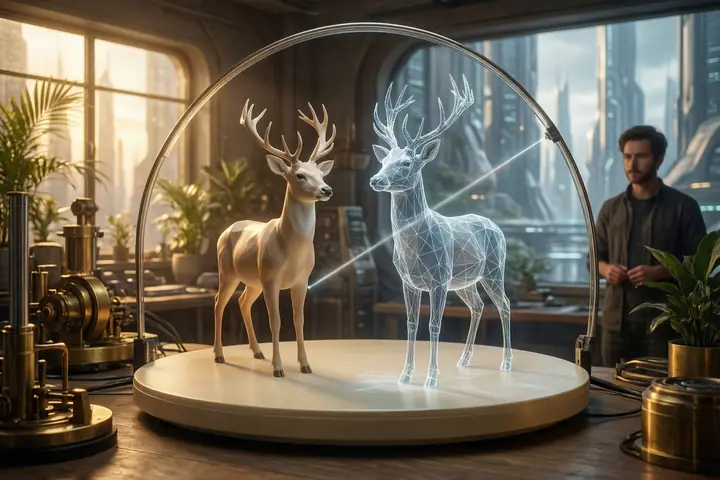 Illustration made with AI image generation; not evidence.